SEO Strategy for B2B Companies (2025)

If your buying committee now looks like a small town hall, you’re not imagining it—and your SEO has to do more than chase head terms. It has to inform, de-risk, and move multiple stakeholders toward a shared decision.
1) What changed in search and B2B buying—and why it matters now
Google folded the Helpful Content system into its core ranking and tightened spam policies in March 2024. The goal: show more people-first pages and cut low-value, mass-produced content. See the specifics in Google’s March 2024 core update and spam policies. Translation for B2B: thin programmatic pages, boilerplate AI text, and outdated libraries will underperform. Invest in depth, originality, and demonstrable expertise.
On performance, Interaction to Next Paint (INP) officially replaced FID as a Core Web Vital in 2024. Google and Chrome teams emphasize reducing main-thread work, breaking up long tasks, and minimizing JS bloat. Practical guidance lives in web.dev’s INP optimization guide. For complex B2B apps and resource-heavy guides, INP is the user-experience tie-breaker.
Meanwhile, buyers are using more channels and more voices to make decisions. McKinsey notes B2B journeys expanded from roughly five to about ten interaction channels since 2016, underscoring the need for omnichannel orchestration across search, email, social, and sales touches—see McKinsey’s 2024 perspective on B2B growth truths. And when decision-makers do engage, credibility matters: the C-suite rewards practical, credible ideas, according to the Edelman–LinkedIn 2024 Thought Leadership Impact Report.
Here’s the deal: in 2025, winning B2B SEO is about mapping intent to every seat at the table, proving authority, and removing friction—technically and psychologically.
2) Map intent to revenue: personas, problems, and topic clusters
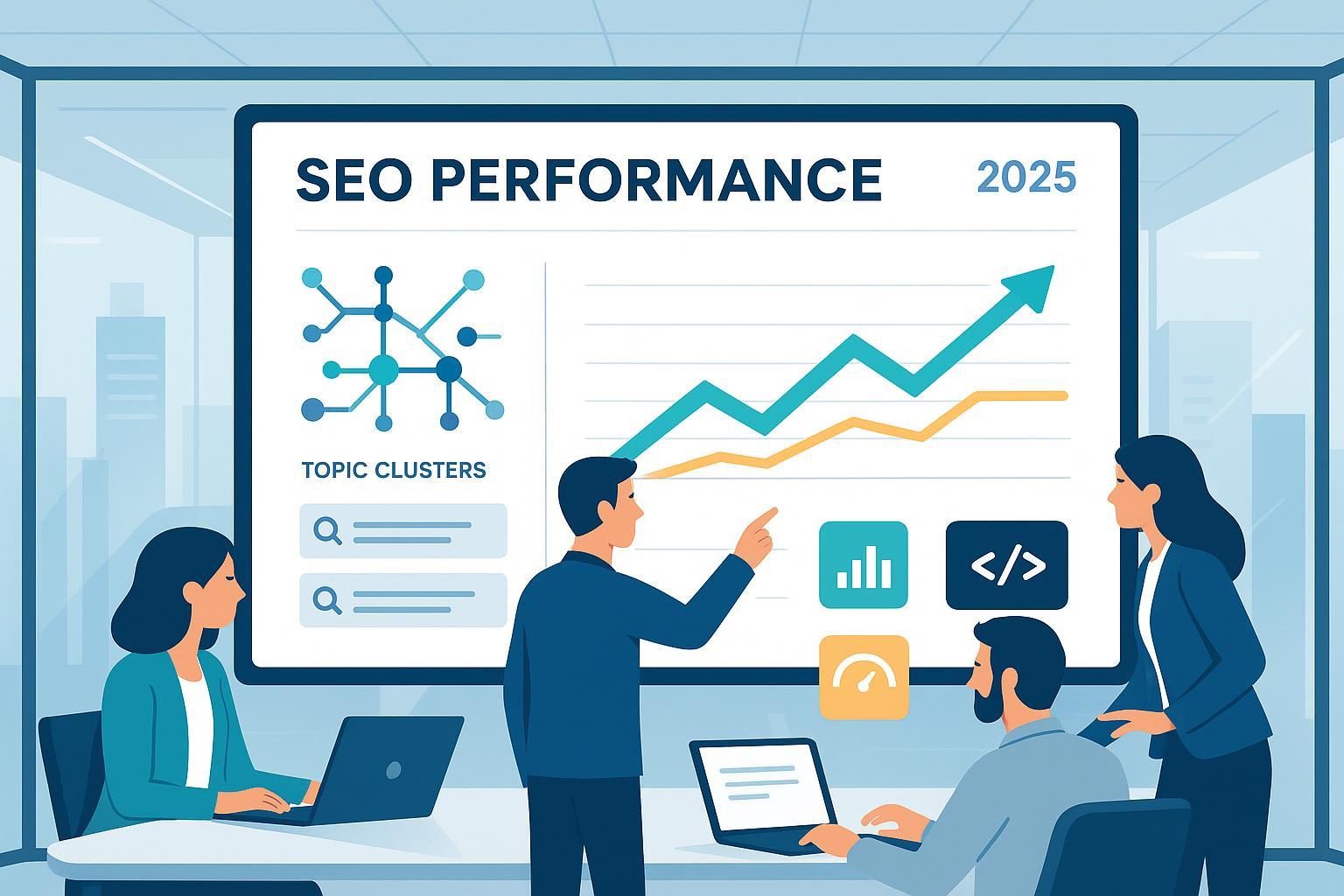
Think of your strategy like a transit map. Your pillar pages are major stations (e.g., “Warehouse Management Software”), and your supporting articles are the lines feeding into those hubs (e.g., “WMS vs. ERP,” “Cycle Counting Methods,” “WMS Implementation Checklist”). Internal links move riders—aka stakeholders—from discovery to decision.
A practical approach:
- Build a stakeholder-intent grid: Finance (ROI, TCO), Operations (workflow fit, integrations), Security/IT (risk, compliance), End users (UX, onboarding), Executives (business outcomes). Translate each into question-style queries and modifiers (cost, comparison, templates, examples).
- Group queries into clusters around clear pillars. Each cluster should have one comprehensive hub that frames the problem, outlines solution approaches, offers calculators/templates, and links to supporting deep dives.
- Plan internal links both ways: supporting → pillar to consolidate topic authority; pillar → supporting to satisfy specific intent. Include breadcrumbs and related-article modules.
Quick workflow (repeat quarterly):
- Harvest queries and SERP patterns from GSC and a competitive tool; tag by persona and journey stage.
- Draft or refactor cluster outlines to close gaps (add missing comparisons, implementation steps, or ROI content).
- Publish or refresh in small batches, then measure incremental impressions/CTR at the cluster level (not just per URL).
3) Technical SEO that compounds: speed, structure, and crawl efficiency
Speed: Target INP < 200 ms where feasible. Reduce main-thread time, defer non-critical scripts, and split long tasks. Heavy JS apps? Consider server-side rendering or partial hydration to get meaningful content interactive sooner. The INP playbook is covered in web.dev’s INP guide (bookmark it for engineering sprints).
Structure: Implement a core schema set to clarify entities and improve search features. B2B priorities include Organization, SoftwareApplication or Product (where eligible), FAQPage/HowTo for support content, Article for thought leadership, VideoObject for demos, and BreadcrumbList. See Google’s primer: Introduction to structured data for Google Search.
Crawl efficiency: Keep sitemaps clean; remove dead ends; standardize canonicals; control faceted navigation; and fix infinite scroll. Run quarterly log-file reviews to find crawl waste, then concentrate PageRank flow into clusters you actually want to rank.
Quarterly technical audit mini-checklist:
- Verify CWV (especially INP) across top 50 revenue-impact pages; prioritize by pipeline influence.
- Revalidate schema with Rich Results Test; fix warnings; ensure author and organization consistency.
- Crawl with authenticated states if your docs or pricing require login to reveal important content for users (but don’t block critical public pages by accident).
- Inspect server response health (5xx/4xx patterns) and JS errors; address regressions before they snowball.
4) Content that wins committees: thought leadership, proof, and product education
Different roles need different proof. The goal is to reduce perceived risk while building consensus.
- Awareness: Industry POVs that reframe the problem, definitions that clarify market terms, and original research. Thought leadership that’s credible—not fluffy—can open doors with executives; see the influence patterns in the Edelman–LinkedIn 2024 Thought Leadership Impact Report.
- Consideration: Comparison guides, technical integration notes, architecture diagrams, implementation checklists, and timeline estimates. Include downloadable artifacts that sales can use.
- Decision: ROI calculators, case studies with timelines and metrics, security/compliance one-pagers, sandbox or demo videos, and references.
| Journey stage | High-performing content formats | Primary KPI to monitor |
|---|---|---|
| Awareness | Definitions, industry POVs, benchmark studies, explainer videos | Impressions, non-brand clicks, assisted MQLs |
| Consideration | Comparison pages, integration guides, implementation checklists, webinars | CTR on high-intent queries, demo sign-ups, content-assisted SQLs |
| Decision | ROI calculator, case studies, security/compliance docs, proof-of-concept videos | Opps created, win rate for organic-sourced deals, time-to-close |
Editorial standards matter: publish bylined experts, cite sources, disclose update logs, and avoid templated intros. Pair every big claim with either data, a customer quote, or a short clip that shows the workflow in action. Ask yourself: would a skeptical CTO find this page specific and verifiable?
5) AI and programmatic SEO—useful, safe, and compliant
AI can speed research and drafting, but quality and intent decide rankings. Google explicitly allows AI-generated content when it’s helpful and original; what violates policy is scaled, low-value content, expired domain abuse, or site reputation abuse. Review the language in Google’s spam policies and March 2024 update.
Guardrails for B2B teams:
- Human-in-the-loop: Subject-matter editors review for accuracy and originality; maintain bylines and editorial notes.
- Entity-first: Reinforce Organization, Product, and Person entities consistently across schema, bios, and knowledge panels.
- Programmatic with substance: If you build scaled pages (industries, integrations), include unique data, configs, screenshots, and case proof per page—never find/replace templates.
6) Measure what the C‑suite cares about: pipeline, not just clicks
Your analytics should tie SEO to pipeline stages—not just sessions.
- Connect GA4 and GSC so you can view search queries alongside onsite behavior and conversions. Setup steps live in GA Help: Link Search Console to GA4 (2024).
- Import offline conversions: push opportunity and revenue milestones from your CRM to GA4 via Data Import or Measurement Protocol so organic influence shows up in dashboards.
- Export GA4 to BigQuery and join with CRM (e.g., Salesforce/HubSpot) to model multi-touch attribution and revenue. Start here: GA4 BigQuery export documentation.
What to show leadership each month:
- Cluster-level view: impressions, clicks, CTR, and assisted conversions per topic cluster, not just per URL.
- Pipeline view: MQL → SQL → Opportunity → Revenue, filtered by First/Last/Assisted-touch Organic.
- Efficiency: content production vs. pipeline impact; time-to-value curves for net-new vs. refreshed content.
Benchmarks are directional, not destiny. Across sources, you’ll often see website visit-to-lead around 2–5% median and enterprise sales cycles of 6–12+ months, with considerable variance by ACV and motion. Use ranges as a conversation starter, then set targets from your own baselines.
7) Execution plan: a 90‑day operating cadence
You don’t need a sprawling rebrand to make progress. Use a tight cadence that compounds.
30 days: Foundation and focus
- Audit top 50 revenue-impact pages for INP, schema, and internal links; fix the worst offenders.
- Build the stakeholder-intent grid and define 3 priority clusters; map gaps against current content.
- Ship two refreshes and one net-new pillar with at least four supporting articles queued.
60 days: Authority and alignment
- Launch one original data asset (mini survey, calculator, or benchmark) and pitch to industry publications.
- Enable GA4↔GSC linking; configure offline conversion imports; QA your pipeline dashboard.
- Roll out comparison and integration pages for Cluster 1; embed demo clips and ROI snippets.
90 days: Scale and prove
- Expand to Clusters 2–3; publish supporting content in batches; tighten crosslinks.
- Run a technical sprint to remove crawl waste and improve server performance for key templates.
- Present a leadership readout: cluster-level growth, influenced revenue, lessons, and next bets.
Closing
B2B SEO in 2025 rewards teams that connect buyer intent to topic clusters, ship technically excellent pages, and prove revenue impact. Build your transit map, keep trains running on time, and let the data direct the next route. Ready to put this playbook in motion? Let’s get your first three clusters scoped this week.