Why Students Are Seeking Authentic Writing Voices Over AI Shortcuts (2025)

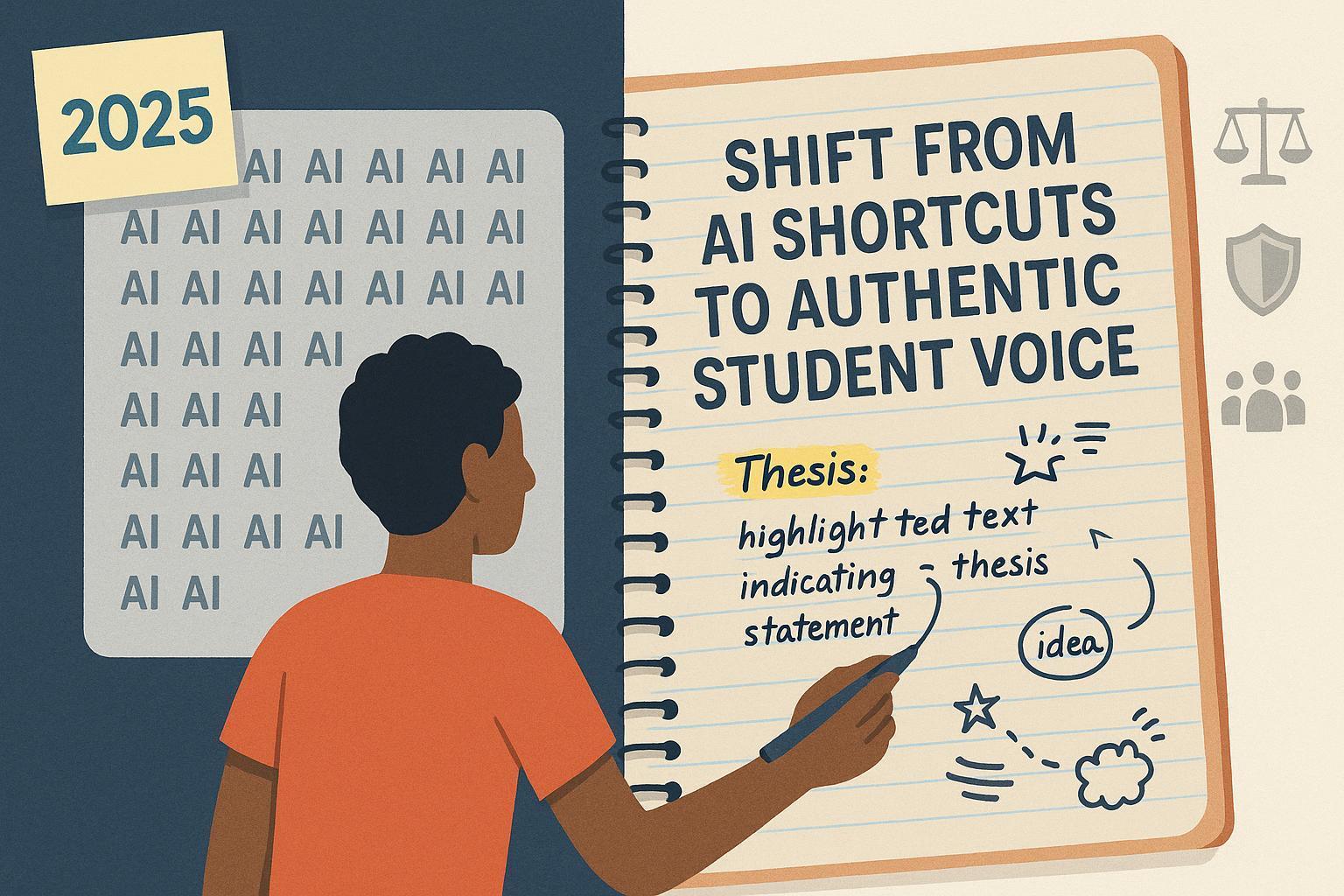
Authentic student voice is having a renaissance in 2025. After two years of scramble around AI detection and policy bans, the center of gravity has shifted: educators are redesigning assignments to foreground original thinking, students are asking for transparent rules that protect fairness, and employers are signaling they value human judgment and communication more than AI-only shortcuts. This isn’t a retreat from technology—it’s a recalibration toward purposeful, ethical AI use that preserves voice.
What’s driving the pivot in 2025
-
Detectors are not enough. Guidance from MIT’s teaching center emphasizes that “AI detection software is far from foolproof,” urging educators to focus on clear guidelines, dialogue, and assignment redesign that promotes critical thinking and voice. See the MIT Sloan EdTech 2025 explainer, “AI Detectors Don’t Work. Here’s What to Do Instead”.
-
Tool features require context. Turnitin’s 2025 documentation describes how its enhanced Similarity Report surfaces AI-writing indicators within highlighted text. These indicators are designed to be interpreted with care, not as standalone proof. For feature specifics, refer to Turnitin’s 2025 guide to AI writing detection in the enhanced Similarity Report.
-
Students want clarity and fairness. Inside Higher Ed’s May 2025 coverage of the AAC&U/Elon student guide reports that students prefer crystal-clear syllabus language about when and how AI tools can be used, and they dislike peers gaining unfair advantages. See Inside Higher Ed’s 2025 analysis of student attitudes on AI and integrity.
Together, these signals are pushing institutions away from “police-and-punish” posture toward transparent policies, process-centric learning, and voice-first pedagogy.
Employer signals: Authentic voice remains a differentiator
-
Microsoft’s 2025 Work Trend Index (WTI) frames the future of work as human–AI teams, where deep AI skills are paired with uniquely human strengths: critical thinking, creativity, and judgment. See Microsoft WorkLab’s 2025 WTI overview.
-
McKinsey’s 2025 research likewise emphasizes collaborative intelligence: algorithms handle data-heavy tasks; humans handle nuance, ethics, and complex decisions—communicating clearly with stakeholders. Evidence is synthesized in McKinsey’s 2025 State of AI report (PDF).
In practical terms, students who develop an authentic, persuasive voice—and can explain when and why they used AI—signal readiness for the workplace.
Voice-first pedagogy: What actually works in the classroom
Educators are finding that the best way to preserve voice is to make the writing process visible and iterative. Consider this design pattern:
-
Proposal and annotated bibliography
- Require a brief proposal that states the thesis and why it matters, plus an annotated bibliography summarizing sources and relevance.
-
Drafting in stages
- Move from outline → rough draft → peer review → instructor conference → final submission. Ask students to include short “process notes” describing any AI use (prompts, snippets) and how they revised to maintain their voice.
-
Oral defense or in-class writing sample
- A low-stakes, five-minute oral explanation (or a brief in-class freewrite) helps triangulate understanding and authorship.
-
Authentic prompts
- Favor assignments that require local data, personal synthesis, or applied scenarios (e.g., propose a campus-specific change backed by interviews and citations). These prompts reduce the payoff of AI-only shortcuts.
-
Reflection memo
- A one-page memo that links claims to sources, explains revision choices, and accounts for any AI assistance.
These strategies align with the broader shift documented in 2025: pedagogy and process—not detection alone—safeguard integrity and cultivate voice.
Detection governance: Advisory tools, strict false-positive caps, human review
The 2025 conversation has matured from “Which detector is best?” to “How do we govern detection without harming students who didn’t cheat?” A recent framework from the University of Chicago’s Becker Friedman Institute proposes policy-level thresholds for false positives, arguing institutions should set strict caps and treat detector outputs as advisory signals reviewed by humans. See BFI’s 2025 working paper on artificial writing and automated detection.
Governance checklist you can adapt:
- Declare detectors advisory-only; never act on an AI flag without human review and a student conversation.
- Set a strict false-positive cap (e.g., ≤0.5–1%) at the policy level; review tool updates and accuracy periodically.
- Maintain a change-log of detector version changes and policy revisions; train faculty on appropriate interpretation.
- Require process artifacts (proposal, drafts, revision logs, reflection memo) to provide context if concerns arise.
For evidence-binding and claim discipline across assignments, many educators benefit from clear editorial standards; see Best Practices for High-Quality Content Creation for Humans and AI for a concise checklist you can adapt to academic contexts.
Practical workflow for students: Ethical AI use that preserves voice
A transparent, human-in-the-loop workflow helps students use AI without surrendering their voice:
-
Brainstorm and structure
- Use AI for idea generation and outline scaffolding, then switch to human drafting. Keep a prompt log.
-
Draft in your own words
- Write the first pass yourself. If you use AI for grammar or clarity suggestions, note what changed and why.
-
Tone and bias checks
- Read aloud; ensure the rhythm and word choice still sound like you. Verify facts and check for bias.
-
Voice alignment checklist
- During revision, scan for “tells” of generic AI prose: overly smooth cadence, filler transitions, vague claims. Replace with specifics, examples, and your personal reasoning.
-
Documentation
- Submit a short reflection memo describing how AI supported brainstorming or editing, and how you preserved your voice.
Example tools that support voice alignment:
- Using QuickCreator’s block-based editor can help students or teams apply a voice checklist during revision while documenting changes.
Disclosure: QuickCreator is our product.
For a deeper look at human-in-the-loop stages, see Best Practices for Content Workflows That Win with Humans & AI in 2025, which outlines where human judgment should stay in the loop.
Micro-example: Preserving voice during AI-assisted editing
Original student paragraph (first draft):
I chose to study food deserts near our campus because it affects my friends and me. When the bus doesn’t run late, grabbing healthy options is harder than grabbing chips. I talked to the night shift at the library—they said they usually eat vending machine snacks.
AI-assisted revision notes (student’s voice preserved):
- Kept the personal motivation and local details.
- Clarified the cause-and-effect link (transit hours → food access → health choices).
- Added one concrete data point from the city’s transit schedule and a citation in the final paper.
Edited paragraph (voice intact):
I focused on food deserts around campus because limited late-night bus service narrows real choices. On nights when routes end before 10 p.m., the vending machine becomes dinner for students working the library shift—something they confirmed in our conversation. City transit data shows the last eastbound Route 3 bus at 9:45 p.m., which leaves a gap when most dining halls are closed.
Note how the student’s tone and local perspective remain central, while the edits improve clarity and evidence.
Implementation notes and change-log
- Policy posture: Favor transparency and process-centric assessment over detector-first decisions.
- Faculty training: Offer short workshops on voice-first assignment design, advisory use of detectors, and ethical AI literacy.
- Student supports: Provide templates for reflection memos and prompt logs; normalize asking for help when uncertain.
Updated on 2025-10-09
- Added detection governance guidance referencing strict false-positive caps.
- Clarified Turnitin’s AI indicator role as contextual, not standalone proof.
- Expanded student workflow with documentation steps and voice checklist.
Quick FAQ
Do AI detectors “work” in 2025?
They can surface signals, but accuracy varies and false positives carry real risk. That’s why teaching centers, including MIT Sloan EdTech in 2025, advise assignment redesign and advisory-only use—see the MIT Sloan EdTech explainer.
How can students keep an authentic voice while using AI?
Draft first in your own words, use AI for brainstorming or light editing, and document changes. Read aloud to catch tone shifts. Instructors can help by requiring process artifacts and reflection memos.
Do employers care about authentic writing?
Yes—2025 employer research from Microsoft and McKinsey emphasizes human judgment, creativity, and clear communication in human–AI teams; see Microsoft’s Work Trend Index 2025 and McKinsey’s 2025 State of AI report.
Closing: Build a culture that champions voice
Institutions that design for voice don’t fear AI—they contextualize it. Start with transparent policy zones, iterative writing, oral checks, and documentation. Use detection tools as advisory signals within a clear governance framework. And support students with ethical AI literacy that keeps their unique voice front and center.
If you’re building a human-in-the-loop content workflow and want a practical blueprint, explore Human-in-the-Loop Publishing for adaptable steps you can apply across courses and departments.