AI vs Traditional SEO: What Works Better in 2025?

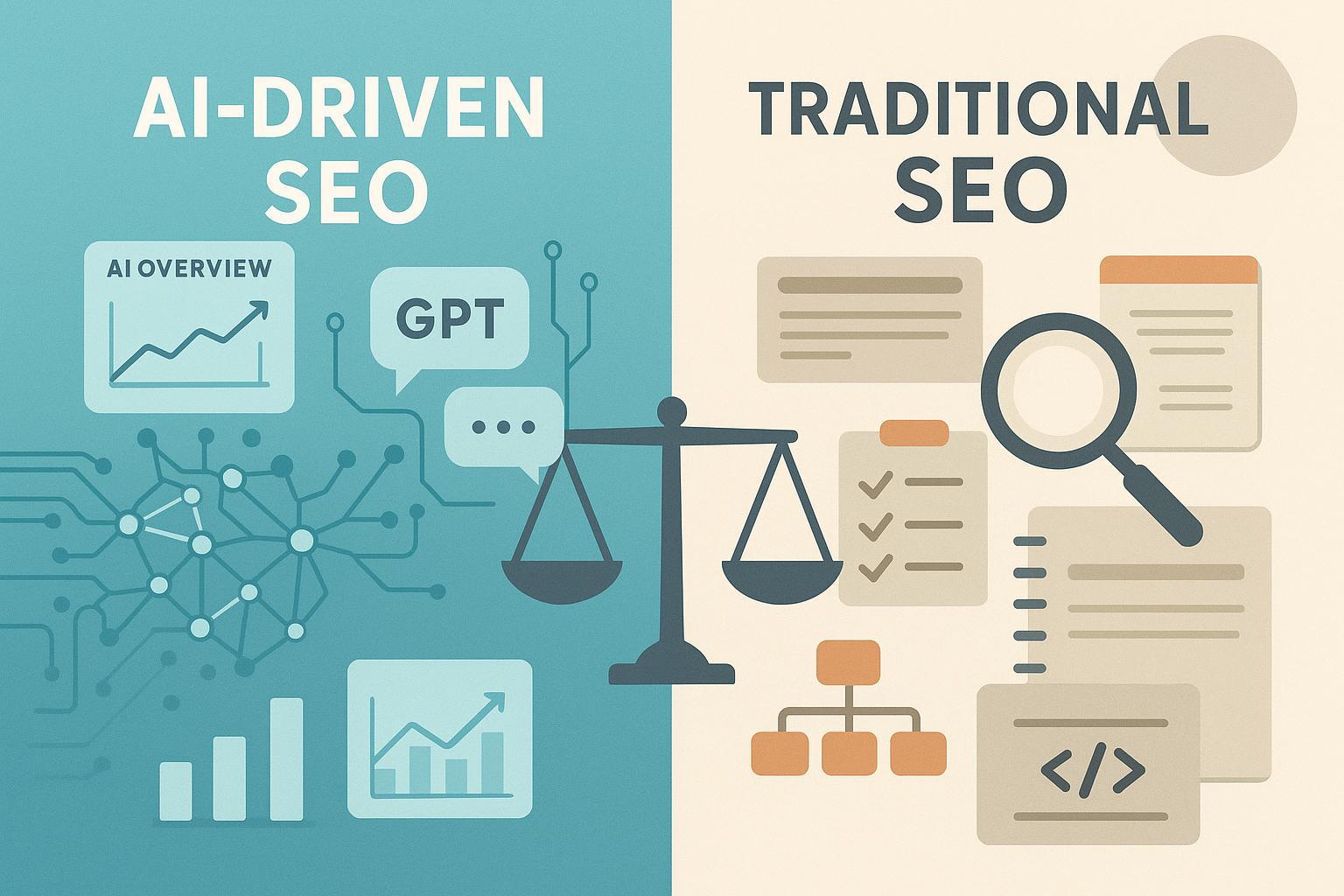
The ground under search shifted again in 2024 and 2025. Google’s March 2024 core update tightened spam policies—explicitly targeting scaled, low-quality content and “site reputation abuse”—while AI Overviews began siphoning clicks from traditional results. If you’re deciding between AI-driven SEO and traditional, human-led SEO, here’s the deal: both can work in 2025, but your mix should match your risk tolerance, resources, and business model.
What we mean by “AI-driven” and “Traditional” SEO
AI-driven SEO uses large language models and automation to accelerate research, drafting, clustering, internal linking, metadata, schema suggestions, and technical checks—ideally with a human editor reviewing before publication. Traditional SEO is human-led: manual research and writing, editorial review, technical audits, and link outreach using standard suites.
If you’re refreshing fundamentals, it helps to revisit metadata and site architecture. For meta titles and descriptions, see the explainer on TDK for SEO. For structuring content and internal links, this guide on SEO silo structure is useful. To align content to topics rather than just keywords, review keywords vs topics. And to keep quality signals front-and-center, you can benchmark drafts with a content quality score.
Quick definitions aside, the core question is how each approach performs under today’s policies and SERP realities.
Head-to-head in 2025: effectiveness, risk, cost, scale, and E-E-A-T
- Effectiveness: AI-assisted workflows can lift production speed and consistency for on-page elements and topic coverage. Traditional workflows tend to produce stronger originality and voice, which helps earn links and trust.
- Risk: Google’s stance is clear—automation isn’t inherently spam, but scaled, unhelpful content is. The March 2024 update expanded enforcement on scaled content and site reputation abuse. Traditional teams still face risk if they publish thin or misleading content; the bar is quality, not the tool.
- Cost & speed: AI can cut drafting time and reduce repetitive tasks. Traditional approaches often require more staff hours per piece. Tool costs vary; treat pricing as directional and match to your volume and governance needs.
- Scalability & governance: AI scales clustering, metadata, and internal links. Without editorial gates, though, scale can become liability. Traditional ops scale through process and staffing; slower, but often steadier.
- E-E-A-T & originality: Traditional SEO more naturally showcases firsthand experience and expertise. AI-assisted content can meet E-E-A-T when subject-matter experts review, authorship is transparent, and sources are cited.
| Dimension | AI-driven SEO | Traditional SEO |
|---|---|---|
| Speed & throughput | Fast drafting; automates metadata, clusters, and internal links | Slower drafting; stronger craft per piece |
| Quality & E-E-A-T | Requires human review, expert bylines, citations, and schema to shine | Naturally strong on originality, voice, and expertise |
| Policy risk | Elevated if scaled without quality controls; acceptable with governance | Lower when quality is high; still penalized for thin/misleading content |
| Cost profile | Tool spend + fewer hours per draft; governance adds overhead | Higher staffing/time per draft; fewer automation costs |
| Scalability | High with automation; watch for generic outputs | Moderate; scale via process and team capacity |
| Best-fit contexts | Large catalogs, briefs, metadata, clustering, content refresh | YMYL topics, brand stories, investigative or original research |
The AI Overviews effect you can’t ignore
AI Overviews (AIO) are appearing in a significant share of queries and tend to depress clicks to traditional listings, especially for informational searches. The exact prevalence and CTR impact vary by study and query mix, but the direction is consistent.
- Prevalence: A March 2025 Semrush study found AIO triggered for roughly 13% of queries, concentrated on informational topics. Broader tracking shows growth into 2025.
- CTR impact: Seer Interactive’s longitudinal analysis through September 2025 reported steep declines in organic CTR on AIO-affected informational queries, with top results losing a large share of clicks. See the evidence synthesized by Seer Interactive’s September 2025 update and corroborating coverage from Search Engine Land.
What this means operationally:
- Both approaches must optimize for answer consolidation. Comprehensive, well-structured articles with clear summaries, FAQs, and schema have a better chance to be referenced or withstand AIO.
- Aim to be the brand cited in Overviews. Evidence-backed sections, precise definitions, and clean markup increase the likelihood of citation.
- Expect lower CTR on informational queries. Lean more on conversion optimization, multi-intent pages, and diversified acquisition (email, social, YouTube, and partnerships).
Guardrails that keep you safe
- Align with Google’s March 2024 policies: The update strengthened enforcement on scaled content abuse, expired domain abuse, and site reputation abuse. The policy stance is that automation is acceptable when used to create helpful content—not to manipulate rankings. See Google’s core update and spam policy explainer (March 2024).
- Enforce human-in-the-loop: AI can draft, but editors shape voice and structure; SMEs fact-check claims; compliance reviews catch issues pre-publication.
- Make E-E-A-T visible: Author credentials, organization info, and Article/Person/Organization schema matter. You can also measure draft quality with a content quality score.
- Strengthen site architecture: Clear silos and internal links help both discovery and user navigation. Refer to SEO silo structure best practices.
- Nail metadata and search intent: Sound titles and descriptions improve CTR resilience. If you need a refresher, revisit TDK fundamentals.
A simple hybrid workflow for 2025
- Discovery and brief: Use AI to draft briefs and clusters, then refine with human insights and SERP analysis.
- Drafting: Generate a structured draft via AI for speed; inject examples, first-hand experience, and data.
- Editorial and SME review: Human editor polishes tone; SME validates facts and adds unique insights.
- On-page optimization: Automate internal links, metadata, and schema suggestions; validate manually.
- Compliance gates: Run a pre-publication checklist for E-E-A-T, citations, and policy alignment.
- Publish and monitor: Track rankings, AIO appearance/citations, CTR, and conversions; iterate.
Best-fit scenarios for 2025
SMBs with lean teams
Use AI to accelerate briefs, drafts, and on-page optimization, but apply a hard rule against bulk publishing without editorial review. Focus on topic clusters, internal linking, and schema. Expect AIO to dampen informational CTR; compensate with conversion-focused layout and lead magnets.
Enterprise content operations
Adopt hybrid automation with governance: editorial gates, SME fact-checking, author schema, audit trails, and data controls. Scale clustering, metadata, and internal links with automation while protecting originality and trust signals.
Agencies and consultants
Build vertical playbooks that combine traditional fundamentals (technical audits, outreach) with AI acceleration for briefs, drafts, and QA. Publish transparent methodologies and track AIO citations to show clients how comprehensive answers and markup can earn visibility even when clicks fall.
YMYL publishers (health, finance, legal)
Favor traditional-first production with AI as an assistive tool. Require expert bylines and disclosures; apply rigorous fact-checking and reduced exposure to scaled automation. Prioritize trust signals and legal/medical review.
eCommerce catalogs
Use AI to scale product and meta copy with human QA. Implement rich structured data and robust internal linking. Ensure unique value in descriptions to avoid thin-content patterns and maintain differentiation across large catalogs.
Local and international SEO
Leverage AI for localization and brief generation, but rely on human reviewers for cultural nuance and legal compliance. Maintain NAP consistency and use local schema. For international sites, align hreflang and region-specific regulations.
Also consider
Disclosure: QuickCreator is our product. If you’re exploring platforms that support AI-assisted workflows with governance, you may find this neutral overview of options helpful: Best blogging platforms with AI writing capability (2025).
How to decide your mix for 2025
- Start with your risk profile: If you operate in YMYL or regulated categories, prioritize traditional-first with AI assists and strict governance.
- Map content types to methods: Use AI for briefs, clustering, metadata, and updates; keep flagship thought leadership and high-stakes pages human-led.
- Design guardrails: Editorial gates, SME reviews, author schema, and policy-aligned checklists.
- Measure beyond rankings: Track AIO presence/citations, CTR resilience, conversion quality, and assisted attribution across channels.
- Iterate quarterly: Revisit your mix as AIO prevalence and policies evolve. Hybrid operations tend to deliver the most resilient results in 2025.
According to Google’s March 2024 policy stance, the differentiator isn’t whether content is AI- or human-made—it’s whether it’s helpful, trustworthy, and original. Build your workflow around that, and both AI-driven and traditional SEO can pull their weight this year.