How AI Helps You Create Thought-Leadership Blogs

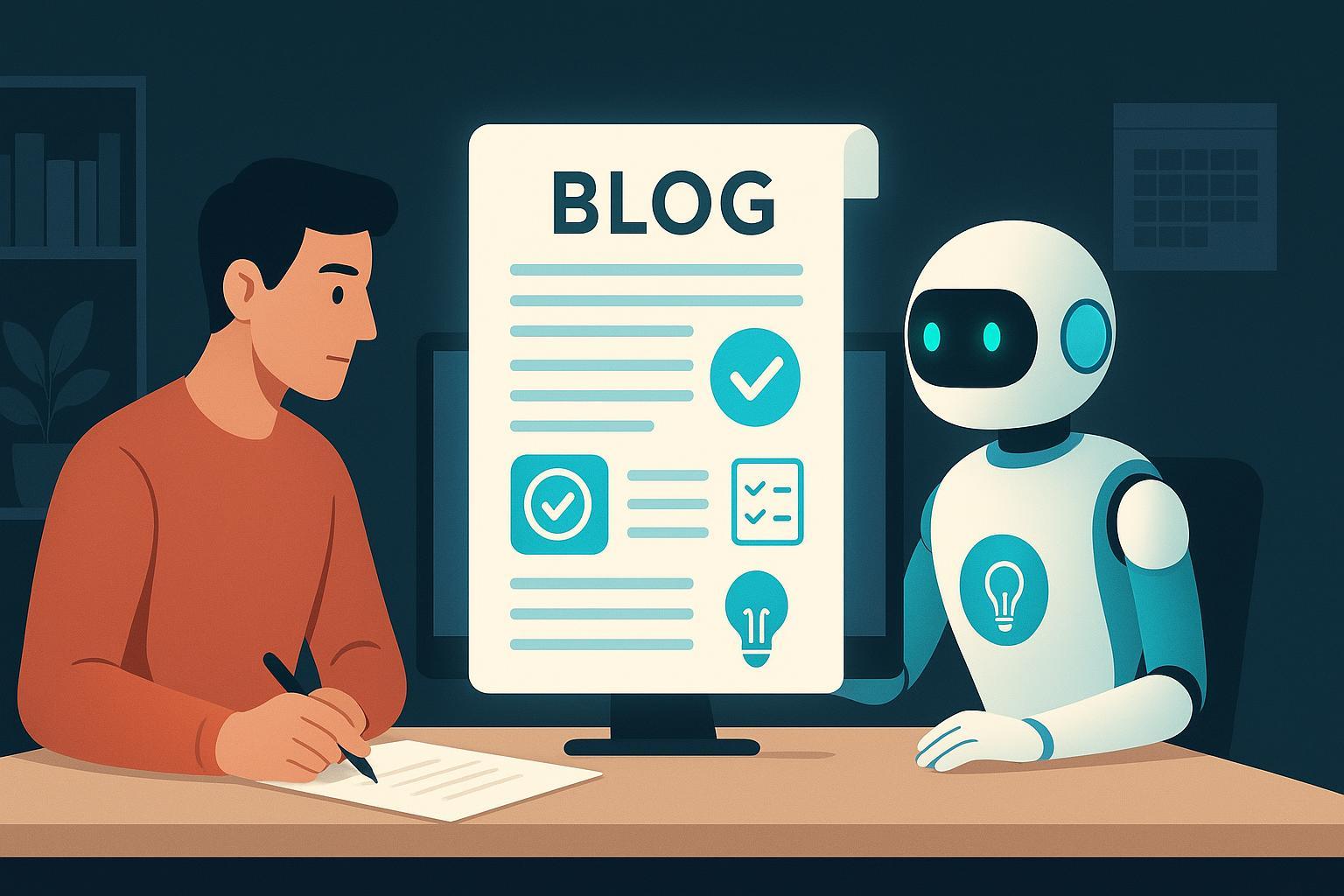
Thought leadership isn’t about publishing more words; it’s about publishing better judgment. AI can speed up research, surface patterns you’d miss, and keep you on schedule. But left unchecked, it can also nudge you into generic takes and thin sourcing. The win comes from pairing AI’s acceleration with your hard-won experience, sound governance, and a rigorous editorial process.
What thought leadership actually demands (and what AI can’t replace)
True thought leadership combines three ingredients: originality (a point of view rooted in lived experience), authority (credentials, outcomes, and citations), and specificity (clear definitions, boundaries, and examples). AI helps you explore angles and draft quickly, but it doesn’t own your stories or your scar tissue. You do. Your role is to supply the lived context, the “what we tried and what we’d do differently,” and the call that others won’t make.
Search platforms echo this quality bar. Google’s policies target mass-produced, unhelpful content regardless of how it’s created. According to Google’s updated spam policies for Search (2024), using automation at scale to create unoriginal pages violates policy; what matters is usefulness and intent. In 2025 guidance on AI-powered results, Google advises focusing on “unique, non-commodity content” and clarifying authorship and provenance, reinforced by structured data and robust bios, as described in Succeeding in AI Search (2025).
Governance first: policy, disclosure, and provenance (ready for 2025)
Here’s the deal: you don’t need to disclose every autocomplete, but when AI substantially shaped your content (e.g., outline exploration, major edits), readers expect transparency. A simple, specific note works. For instance: “This article used AI to explore outline options and assist with copy edits; all analysis, examples, and final decisions are mine.” Then back it up with guardrails that protect trust. The FTC’s 2024 final rule banning fake reviews and testimonials and its Endorsement Guides require clear, conspicuous disclosures and prohibit synthetic or deceptive endorsements. Align your program with NIST’s Generative AI profile inside the AI Risk Management Framework, which emphasizes accuracy controls, transparency, and documentation of limitations; see NIST’s Generative AI Profile (2024). And for visuals, consider embedding Content Credentials so audiences can see what was generated and what was edited; the Content Authenticity Initiative’s 2025 conformance program strengthens interoperability, per the C2PA/CAI announcement (2025).
The human-in-the-loop workflow that scales quality
You don’t need a labyrinth of steps—just a consistent path that keeps the human voice central.
-
Intake and intent map Define the audience, problem, and outcome. Write a one‑line thesis and 3–5 claims you intend to substantiate. Note any proprietary data or lived experiences you’ll use. Decide now if a disclosure is warranted.
-
Research and evidence binding Use AI to collect candidate sources, then personally verify each claim. Favor primary, date‑stamped sources (original research, official docs). Summarize insights in your own words. Keep a mini log of quotes with links and dates.
-
Draft scaffolding with mandatory human blocks Let AI propose outline variants and transitions. Then write the non‑negotiables yourself: your story, your contrarian take, your “lessons learned.” If AI suggests facts, require a linkable source and verify it.
-
Fact-check and E-E-A-T audit Manually verify claims and dates. Ensure citations point to original sources. Add an author line with credentials that match the topic. If you used AI materially, include a brief disclosure.
-
Publish, distribute, and measure Add Article and Person schema to clarify authorship and help Search interpret the page. Google’s docs provide examples for Article structured data and Person structured data. Distribute via author-led channels (LinkedIn posts, conference tie-ins) and track quality metrics (see below).
Who does what: a compact RACI
| Stage | Responsible (does the work) | Accountable (final say) | Consulted | Informed |
|---|---|---|---|---|
| Intake/brief | Content strategist or author | Editor | SME, Legal (as needed) | Marketing lead |
| Research & citations | Researcher or author | Editor | SME | Marketing lead |
| Drafting | Author (with AI assist) | Editor | Designer (for visuals) | Marketing lead |
| Fact-check & QA | Editor | Managing editor | Legal (risk review) | Stakeholders |
| Schema & publish | SEO/ops | Editor | Dev (as needed) | Team |
| Distribution & measurement | Marketing ops | Marketing lead | Sales/Comms | Execs |
Prompt patterns that pull out real expertise
Think of prompts as creative briefs for a very fast collaborator. The goal is not to get a finished post but to surface angles, contrasts, and gaps you can own.
- Angle expansion: “List five contrarian takes a seasoned [role] might argue about [topic]. For each, add when it holds, when it fails, and an example from B2B.”
- Story mining: “Ask me 10 questions to extract a personal failure and what I changed afterward related to [topic]. Organize questions from setup to pivot to outcome.”
- Evidence guardrail: “Suggest 5 claims commonly made about [topic] that require primary sources. For each, propose an authoritative source type to verify (e.g., government stat, academic study).”
- Reader tests: “Draft two 150‑word openings: one narrative, one data‑led. I’ll pick one and rewrite with my story.”
Use them to think better, not to skip thinking.
Editorial QA: a minimal checklist that prevents retractions
A fast checklist beats a perfect one you never use. Before publishing, verify claims against primary, date‑stamped sources with links to originals; contextualize quotes and data with scope, year, and noted limitations; ensure the author line includes relevant credentials and add a short disclosure if AI materially assisted; run an originality scan and replace overlaps with your own examples; label images with provenance (and consider Content Credentials when AI-assisted); and add Article and Person schema with a byline that links to a robust author bio. Journalism groups reinforce these norms. Poynter’s 2024 audience research indicates readers want disclosure when AI is used and assurance that a human verified outputs; see Poynter’s summary of audience attitudes (2024).
SEO and credibility signals that actually help
- Clarity beats cleverness: State the specific problem and who it’s for in the first 100–150 words. Use precise language and define any loaded terms.
- Entity clarity: Use consistent names for people, organizations, and concepts. Link once to the most authoritative source.
- Authorship and schema: Implement Article/BlogPosting and Person schema and maintain detailed author bio pages that match the topic’s expertise.
- Transparent sourcing: When a number does the heavy lifting, put it in the sentence and link the original report once.
Metrics that prove it’s working (and when to adjust)
Is the program creating commercial and reputational lift, not just volume? Track signals that connect quality to outcomes:
- Influence and receptivity: The Edelman–LinkedIn studies show decision‑makers are more receptive to outreach and more willing to pay a premium when they encounter consistent, high‑quality thought leadership. See the 2024 Edelman–LinkedIn B2B Thought Leadership Impact Report (PDF) and the 2025 report hub for up‑to‑date benchmarks.
- Time-to-publish and accuracy: Track assisted production time, number of editor revisions, and post‑publish corrections.
- Engagement quality: Depth of scroll, time on page, saves, and executive comments—not just clicks.
- Pipeline influence: Self‑reported attribution, sourced opportunities tied to posts, and conference invites that cite your content.
For adoption baselines and maturity context, McKinsey’s 2025 State of AI describes broad uptake with value concentrated among “high performers.” See McKinsey’s State of AI 2025 hub for current exhibits to calibrate your expectations.
Common pitfalls—and how to avoid them
Watch for commodity phrasing (inject a personal story, boundary condition, or a quick diagram), source drift (never let AI be the source of truth; verify with originals), over‑automation (keep the thesis and judgment calls human), opaque imagery (mark AI‑assisted visuals with provenance and, where possible, Content Credentials), and governance gaps (publish a brief disclosure policy and apply it consistently).
A pragmatic path forward
Start with one article and a lightweight workflow: an intake brief, AI‑assisted outline exploration, your lived-experience sections, a tight QA pass, and a short disclosure if warranted. Measure outcomes for a month. Then tune prompts, expand your citation playbook, and layer in schema and provenance. Want a quick test? Would you stand on a stage, put your name on this piece, and field questions from peers? If the answer is yes, you’re on the right track.
Small operational tip: If you’re building a content ops hub, a single workspace that codifies prompts, approvals, and measurement can help—Airtable’s guide offers examples of adoption guardrails and QC steps; see Airtable’s AI content marketing overview for 2025‑oriented practices.