AI-Powered Agency Growth Strategies: A 2025 Playbook That Scales Beyond Pilots

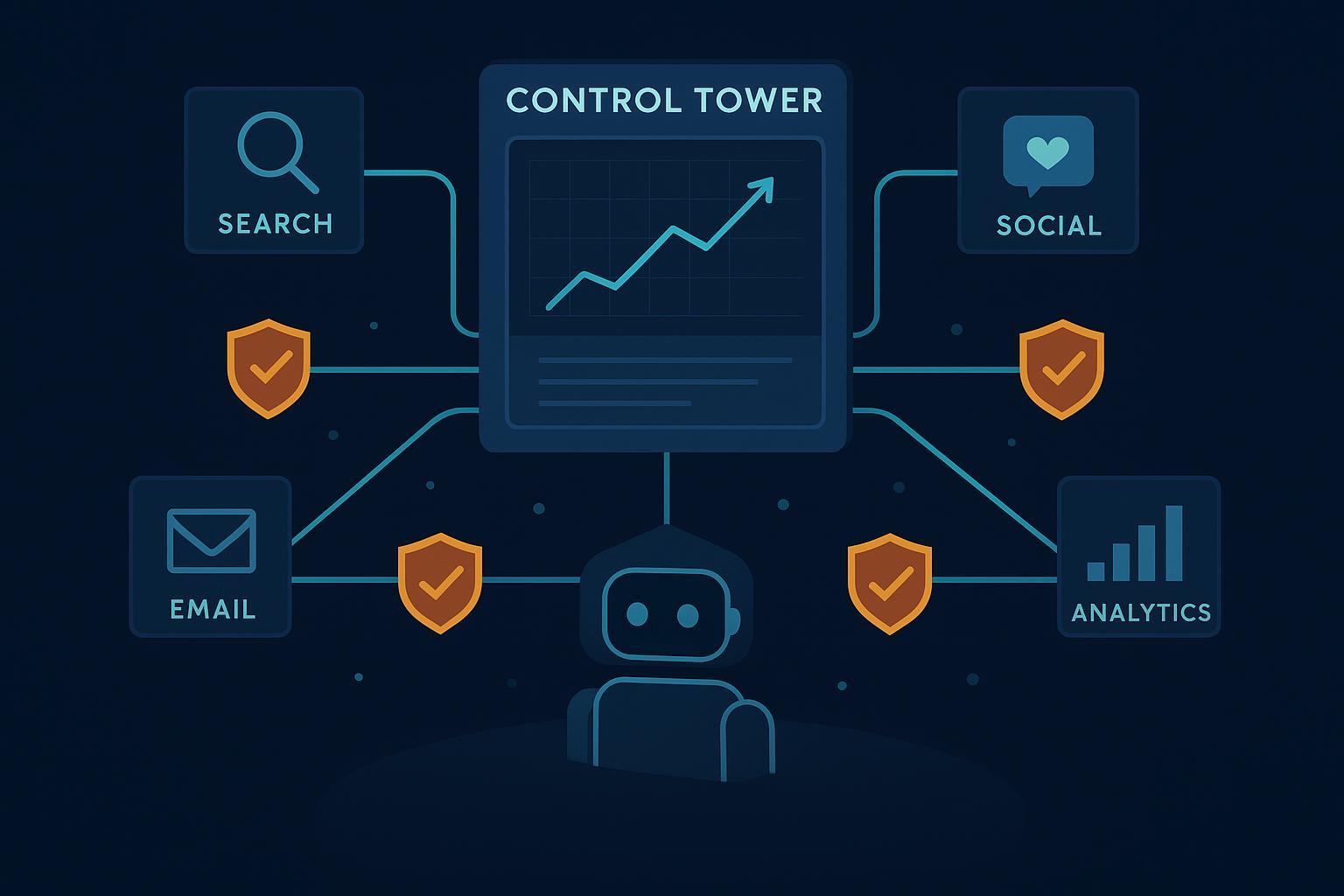
Budgets are tight and expectations are rising. Gartner’s latest CMO survey—summarized by Campaign Asia in June 2025—shows marketing budgets hovering around 7.7% of revenue, which compresses headroom for experimentation. Meanwhile, according to McKinsey’s 2025 State of AI, only about 1% of companies self-report at true AI maturity. The message for agencies is clear: the winners won’t be the ones chasing shiny tools; they’ll be the ones operationalizing AI—measurably, safely, and at scale.
What follows is a practical model you can run this quarter: a maturity map, a 360° operating framework, credible metrics, and a 90-day plan to turn AI from scattered pilots into repeatable growth.
The AI Agency Growth Maturity Model (2025)
Think of this as your altitude chart. Where you are on this curve should determine what you ship next—not the other way around.
| Phase | Defining traits | Primary goals | KPI focus |
|---|---|---|---|
| 0. Ad hoc pilots | Isolated tool trials; hero PMs doing manual QA; little governance | Prove value on small, low-risk tasks | Task time saved; defect rate; stakeholder satisfaction |
| 1. Programmatic adoption | Standardized workflows and prompts; QA gates; initial risk register | Consistency and quality; early compliance scaffolding | Cycle time; first-pass acceptance; rework rate |
| 2. Integrated value chain | CRM/MAP/CDP data wired in; unified measurement (MMM+MTA); role redesign | Cross-functional throughput and attribution clarity | Lead quality; CAC/LTV shifts; assisted revenue |
| 3. Agentic orchestration | Multiagent workflows; control tower approvals; spend caps; fine-grained permissions | Hands-off execution with guardrails | Time-to-launch; errors caught pre-release; budget adherence |
| 4. Scaled services & monetization | Productized offers; outcome-based pricing; continuous model evaluation | Growth at sustainable margins | Gross margin; win rate; NRR/expansion revenue |
A 360° Framework for Scaling with AI
1) Readiness: data, consent, and measurement
If your data foundations are brittle, AI will simply move faster in the wrong direction. Start with a quick inventory: what customer events hit your CDP/CRM, what consent signals are recorded, and how attribution is handled. Build a working measurement layer (MMM for long-term signal; MTA or experiments for near-term truth). Document roles and escalation paths so approvals don’t bottleneck.
2) Adoption: standardize high-impact use cases
Pick a few repeatable, high-value workflows—creative variants, search structure and copy, audience expansion, reporting drafts. Create prompt libraries, QA checklists, and definition-of-done criteria so the output is consistent across teams. Aim for first-pass acceptance rates above 70% within a month; if you’re nowhere near that, your prompts, training data, or guardrails need work.
3) Service differentiation: productize what works
Agencies that grow in 2025 don’t sell “hours with AI,” they sell outcomes with artifacts. Package what you prove: “AI CRO sprints,” “Audience intelligence pods,” “Agentic brand concierge,” or “MMM+incrementality accelerator.” Define inclusions, SLAs, and handoffs. Price to value, and include performance safeguards (e.g., minimum data quality thresholds) to protect margin.
4) Agentic orchestration at scale
Once your workflows are predictable, orchestrate multiagent systems with a control tower. Boston Consulting Group describes agentic AI as coordinated agents that can analyze data, decide, and act across enterprise platforms—with risk-tiered autonomy and governance. Borrow the pattern, then tailor it: define which actions require human sign-off (budget changes, novel creative in regulated categories), set role-based permissions, and log every material action for auditability.
5) Risk and governance: build once, reuse everywhere
Governance shouldn’t be a tax on speed; it should be a multiplier. Use the NIST AI Risk Management Framework to structure risks and controls across the lifecycle. If you work with EU clients, track the EU AI Act milestones—transparency and certain model obligations began phasing in during 2025, with broader applicability in 2026. Maintain model cards, decision logs, and DPIAs where appropriate, and train teams on disclosures, bias checks, and copyright/IP hygiene.
Cases and the metrics that matter
Two credible evidence points help calibrate expectations and guide measurement design.
- Adobe’s internal program shows how better data and measurement compound over time: using Mix Modeler, Adobe reports an 80% increase in return on media spend across five years and a 75% rise in media’s share of digital subscriptions.
- Google’s AI-led Search and Performance Max guidance points to up to 27% more conversions at comparable CPA/ROAS when setups follow AI-forward best practices. Results vary by context, but the direction is consistent: when structure, signals, and creative quality align, AI optimization finds more high-probability demand.
What should agencies track to make these wins client-visible? Focus on conversion quality (qualified MQL/SQO rates and downstream revenue), time-to-launch and change latency (how quickly campaigns go from brief to live, and from signal to adjustment), error interception (issues caught by QA or approvals before they reach the public), and cost-to-serve (hours per deliverable and per optimization cycle). When you present impact, tie improvements to specific process changes and governance upgrades—clients trust systems, not miracles.
Tooling trade-offs you can’t afford to ignore
Your stack is a portfolio of trade-offs, not a shopping list. Depth of integration raises the ceiling on performance but increases setup time and operational complexity; lighter stacks get you to market faster but can stall when you need unified identity and measurement.
- Data and identity layers (CDP/CRM) enable audience precision and suppression, but only if consent and event quality are trustworthy.
- Orchestration and marketing automation speed execution; without clear prompts and QA gates, you’ll “scale” rework.
- Media and measurement systems reward clean structure: standardized naming, budget guardrails, and hypothesis-driven tests.
- Creative pipelines must embed brand rules, licensing, and rights management so assets are safe to scale.
One more practical lens: total cost of ownership. Include licenses, compute, governance (audits, documentation, training), and change management. The cheapest tool that your team can’t operate is the most expensive line item you’ll carry.
Measurement and commercial models that scale
Agencies that master AI also master proof. Blend MMM for strategic signal with shorter-cycle truth from incrementality experiments and MTA where viable. Standardize experimentation charters with clear hypotheses, confidence thresholds, and decision rules.
Commercially, move beyond hourly billing. Consider value-tiered pricing for productized services, outcome-indexed components when you have measurement you trust, and floors/guardrails to protect downside when external factors (supply chain, seasonality) dominate performance. Performance pay without attribution maturity is just gambling.
Your first 90 days: a focused action plan
- Weeks 1–2: Run a readiness sprint. Map two lighthouse workflows (e.g., search + creative variants). Stand up a lightweight risk register, model cards, and approval rules aligned to NIST-style categories. Confirm data consent signals and decide how you’ll measure (MMM baseline + at least one clean incrementality test).
- Weeks 3–6: Standardize the work. Finalize prompts, checklists, and definition-of-done. Launch the two lighthouse use cases with clear success metrics (first-pass acceptance, time-to-launch, conversion quality). Create a one-page QA/approval guide and train every contributor.
- Weeks 7–10: Productize and price. Turn the validated workflows into named offers with inclusions, SLAs, and pricing. Draft a short case vignette for each, using before/after metrics and a diagram of the workflow.
- Weeks 11–12: Orchestrate and scale. Add a control-tower layer (approvals, spend caps, action logs). Automate the boring parts (naming, tagging, alerts). Schedule a governance review to retire manual steps that no longer add value.
Common pitfalls (and how to sidestep them)
- Starting with a tool, not a workflow. Pick the job-to-be-done, then fit the stack.
- Measuring activity, not impact. “100 assets shipped” is nice; “A/B-tested variant reduced CAC 12%” is evidence.
- Ignoring approvals until something breaks. Define “material actions” and require sign-off before money moves or risky creative goes live.
- Underfunding change management. Your biggest gains come from role redesign and training, not yet another license.
What’s next
Make AI a capability, not a campaign. Use the maturity model to decide your next move, the 360° framework to execute, and the 90-day plan to prove it works. Want a litmus test? If your team can explain how data, prompts, approvals, and measurement fit together for one productized service—without opening a slide—you’re on the right track.
Sources and further reading with inline anchors:
- According to McKinsey’s State of AI 2025.
- Gartner budget environment via Campaign Asia’s June 2025 coverage.
- Adobe’s measurement-led ROI lift in the Mix Modeler case study.
- Google’s AI-led Search guidance from Think with Google.
- Governance blueprint in NIST’s AI Risk Management Framework.
- EU obligations and timelines on the European Commission’s EU AI Act page.
- Multiagent orchestration perspective from BCG’s agentic AI overview.