How AI Helps You Create Pillar Content (2025 Best Practices)

If you’re building topical authority this year, AI can make pillar content faster to plan, draft, and maintain—without sacrificing accuracy or voice. The catch? Governance and smart workflows decide whether that speed compounds into sustainable rankings or collapses into thin, forgettable pages.
What Pillar Content Is—and Why AI Helps
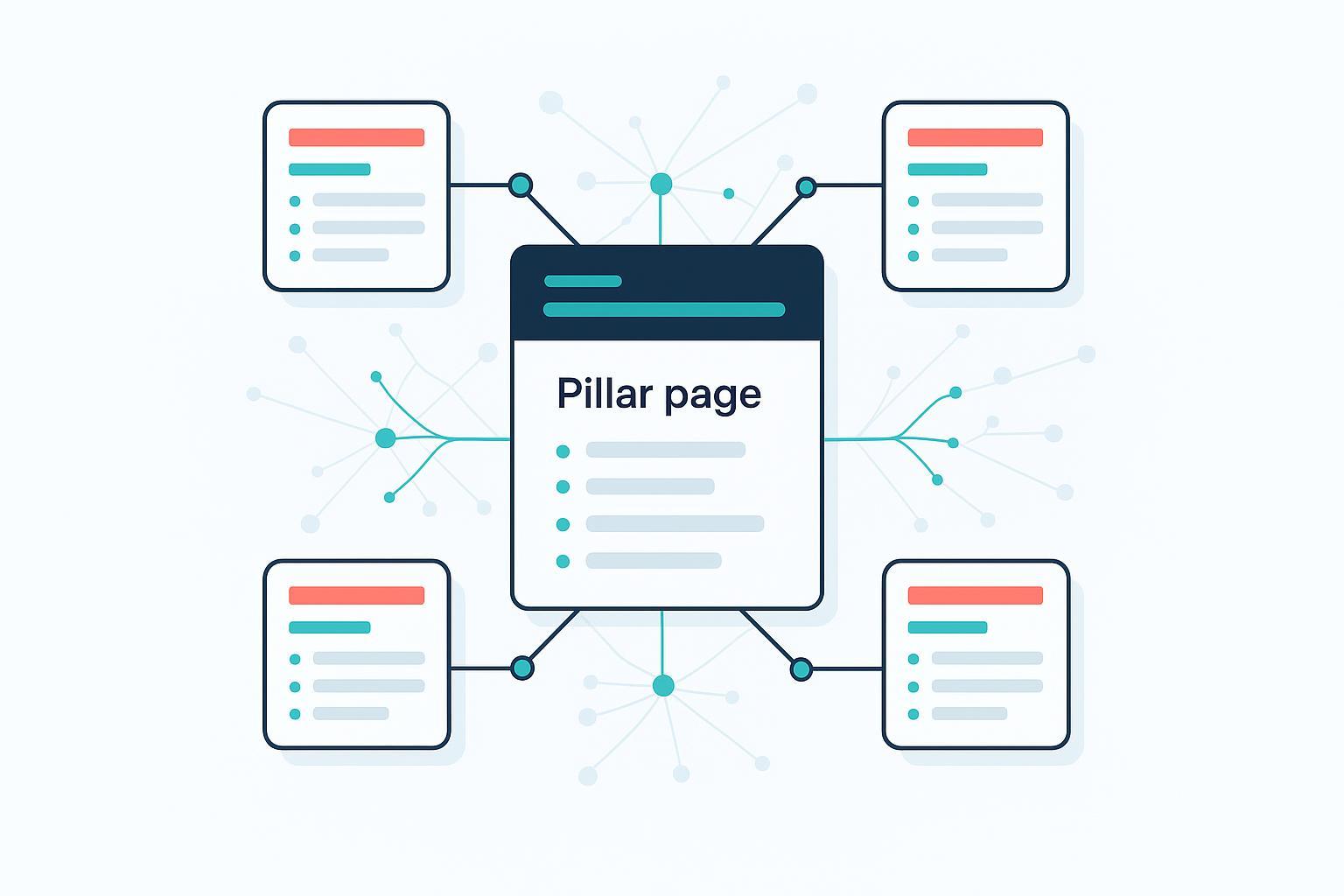
A pillar page is the comprehensive, navigable resource that anchors a cluster of related articles. Think of it as the hub; each cluster article is a spoke addressing a discrete intent or long‑tail query, with reciprocal internal links that tie the whole system together. This model is widely used and documented. For example, Backlinko describes topic clusters as groups of pages organized around a single pillar—complete with interlinking to improve structure and SEO—in their 2025 overview of topic clusters. HubSpot’s knowledge base explains pillar pages as broad guides that point readers to high‑quality subtopic pages and improve findability, documented in pillar pages, topics, and subtopics (2024). MarketMuse emphasizes deep coverage across subtopics and strong internal linking in what are topic clusters (2025).
Why does AI fit here? It excels at pattern recognition, summarizing scattered research, and proposing organized outlines. Used well, AI accelerates ideation, drafting, and optimization while humans provide strategy, originality, and quality control. The result is a faster path to a thorough hub‑and‑spoke structure that actually helps readers.
A Practical Human‑AI Workflow for Pillar Creation
Here’s a repeatable workflow that balances AI speed with human judgment.
- Strategy and topic selection
- Human: Choose a core topic based on audience needs, product/service relevance, and search demand. Define success criteria (traffic, rankings, assisted conversions).
- AI: Summarize existing SERPs, forums, and FAQs; propose candidate subtopics grouped by user intent and funnel stage.
- Cluster mapping and brief creation
- Human: Approve the cluster map; ensure each article targets a distinct intent to avoid cannibalization.
- AI: Generate briefs with target keywords, searcher questions, outline sections, and reference sources to validate claims.
- Drafting and enrichment
- AI: Produce first drafts for the pillar and clusters; flag areas needing proprietary insights, data, or visuals.
- Human: Add unique experience—screenshots, firsthand process notes, customer quotes, and examples. Tighten voice and ensure accuracy.
- Optimization and interlinking
- AI: Suggest schema (FAQ, HowTo where appropriate), meta descriptions, opportunity gaps, and internal link anchor suggestions.
- Human: Finalize headings, internal links, and on‑page UX (jump links, scannable sections). Enforce brand standards.
- Publishing and promotion
- AI: Repurpose pillar sections into social posts, email snippets, and short video scripts.
- Human: Approve channels, tailor messaging, and run A/B tests.
Role map: who does what
| Stage | Human role | AI role |
|---|---|---|
| Strategy | Choose topic, goals, guardrails | Surface patterns, subtopics, questions |
| Mapping & briefs | Approve intents, avoid cannibalization | Generate outlines, briefs, source suggestions |
| Drafting | Insert expertise, examples, voice | Produce first drafts, catch structure gaps |
| Optimization | Final SEO decisions, UX, links | Schema ideas, meta, gap analysis |
| Publishing & promotion | Channel selection, QA | Repurpose content, drafts for social/email |
| Measurement & refresh | Interpret data, prioritize updates | Detect decay patterns, recommend changes |
Prompts That Actually Move the Work Forward
Good prompts are specific about audience, intent, and outputs. Adapt these to your stack.
You are a content strategist helping build a pillar page on [core topic].
- Audience & stage: [persona], [funnel stage]
- Output: An H2/H3 outline for a comprehensive pillar; list 12–18 cluster article ideas grouped by intent.
- Include: FAQs, suggested schema (FAQ/HowTo), and 10 internal link anchor suggestions to use from clusters back to the pillar.
- Cite: Propose 3–5 authoritative sources to consult (publisher + year).
For cluster drafting, layer constraints: “Write a first draft targeting [intent], include 3 data points with sources dated 2024–2025, add one customer‑example vignette, and propose two visuals (diagram or screenshot).” For optimization: “Compare our draft against top 3 competitors; list content gaps and suggest schema, meta, and internal link anchors.” For repurposing: “Turn the pillar’s H2 sections into 5 LinkedIn posts and 2 newsletter blurbs; keep voice consistent.”
Governance That Aligns With Google’s Policies
Google’s stance is clear: quality and purpose matter more than how content is produced. The March 2024 core update tightened spam policies, targeting scaled content abuse, expired domain abuse, and site reputation patterns. Google’s team wrote that the update aims to reduce low‑quality results and outlined enforcement details in the Developers Blog (2024), with further context in the Product Blog on the March 2024 update. Their Spam Policies for Google Web Search (2025) stress that generating content at scale purely to manipulate rankings—via automation or humans—violates policy. Separately, Google introduced AI Overviews in May 2024, described in the Product Blog announcement, reinforcing that high‑quality source content remains essential even as AI appears in search experiences.
What does this mean for your pillar content?
- Make it people‑first: prioritize original insights, clear explanations, and evidence. Include expert quotes and screenshots where relevant.
- Cover distinct intents: ensure each cluster page solves a unique need; consolidate near‑duplicates.
- Strengthen E‑E‑A‑T: publish author bios, cite authoritative sources with publisher names and years, and maintain review notes and change logs.
Lifecycle Management: Refresh Cadence and Measurement
Pillar content is an ecosystem, not a one‑off project. Plan for audits, updates, and ongoing measurement.
- Audit cadence: Quarterly or biannual reviews work for most teams. Practical CLM guidance appears across industry resources, including Heretto’s content lifecycle management (2024), Bynder’s five CLM stages (2024), and Canto’s CLM overview (2024).
- Detecting content decay: Watch declining impressions, rankings, and engagement signals (scroll depth, dwell time). Seotistics outlines methods to identify decay in content decay (2025).
- Optimization tooling: AI‑enabled systems can surface gaps and competitor shifts; Single Grain’s 2025 guide to AI content optimization tools summarizes current approaches.
- Measurement stack: Track acquisition (impressions, CTR), engagement (time on page, scroll), conversion (micro/macro), and content health. For incrementality, triangulate using MMM/MTA/experiments as discussed by Rockerbox in marketing measurement triangulation (2024) and Northbeam’s 2024 guide to incrementality.
A simple rule: when rankings or engagement slide after the maturity window (often around 12 months for evergreen topics), schedule a refresh. Replace dated screenshots, add recent data, update examples, and re‑evaluate internal links.
Micro‑Case: What Teams Are Seeing
Public case evidence shows what’s possible when clusters are engineered with intent clarity and ongoing refresh.
- Xponent21 reported dramatic organic growth by optimizing for AI search and citations—engineering topic clusters that achieved top rankings in Perplexity, ChatGPT, and Google’s AI experiences. Read their AI SEO case study (2025) for the workflow highlights and ranking outcomes.
- SurferSEO compiled firsthand accounts including Airmason’s multi‑month traffic growth using AI‑powered topical clustering. See their collection of SEO case studies (2025) for patterns and caveats.
What’s replicable? Clear topic selection, distinct intent mapping, consistent interlinking, human enrichment (original examples and visuals), and disciplined refresh cadence. What isn’t guaranteed? Exact traffic multipliers—your market, domain authority, and publishing velocity all matter.
Pitfalls and Recovery Playbook
Common traps in AI‑assisted pillar programs:
- Thin clusters and cannibalization: Multiple articles chasing slight keyword variations produce doorway‑like content. Recovery: Merge or redirect duplicates; target a single intent per article; re‑write with richer examples.
- Over‑automation: Large volumes of lightly edited drafts invite quality issues and policy risk. Recovery: Institute editorial sign‑off, require citations for claims, and add firsthand insights to lift originality.
- Measurement blind spots: Attribution noise obscures the content’s value. Recovery: Run simple experiments (pre/post refresh windows, holdout tests), and triangulate MMM/MTA rather than relying on last‑click.
- Refresh debt: Content decays when updates are skipped. Recovery: Put the pillar/cluster ecosystem on a calendar; review top performers quarterly and the long tail biannually.
Your Next 90 Days: An Action Plan
Month 1
- Choose one core topic aligned to business outcomes; define KPIs.
- Use AI to propose a cluster map with 12–18 subtopics grouped by intent; validate and prune.
- Generate briefs for the pillar and top 6 clusters; assign owners and timelines.
Month 2
- Draft pillar and first 6 clusters using AI; add human enrichment (screenshots, quotes, proprietary examples).
- Optimize pages: schema, meta, internal links; publish and set up analytics and dashboards.
Month 3
- Promote and repurpose across channels; run A/B tests on headlines and intro hooks.
- Measure early signals; fix gaps; schedule refreshes; document prompts, sources, and change logs.
Keep going: expand the cluster, refresh based on decay signals, and iterate on interlinking.
If you want pillar content that wins in 2025, pair AI’s speed with your team’s experience—map clear intents, add real expertise, and keep refreshing. Ready to build authority that lasts? Let’s get to work.