How AI-powered medical research writing tools are transforming academic content creation in 2025

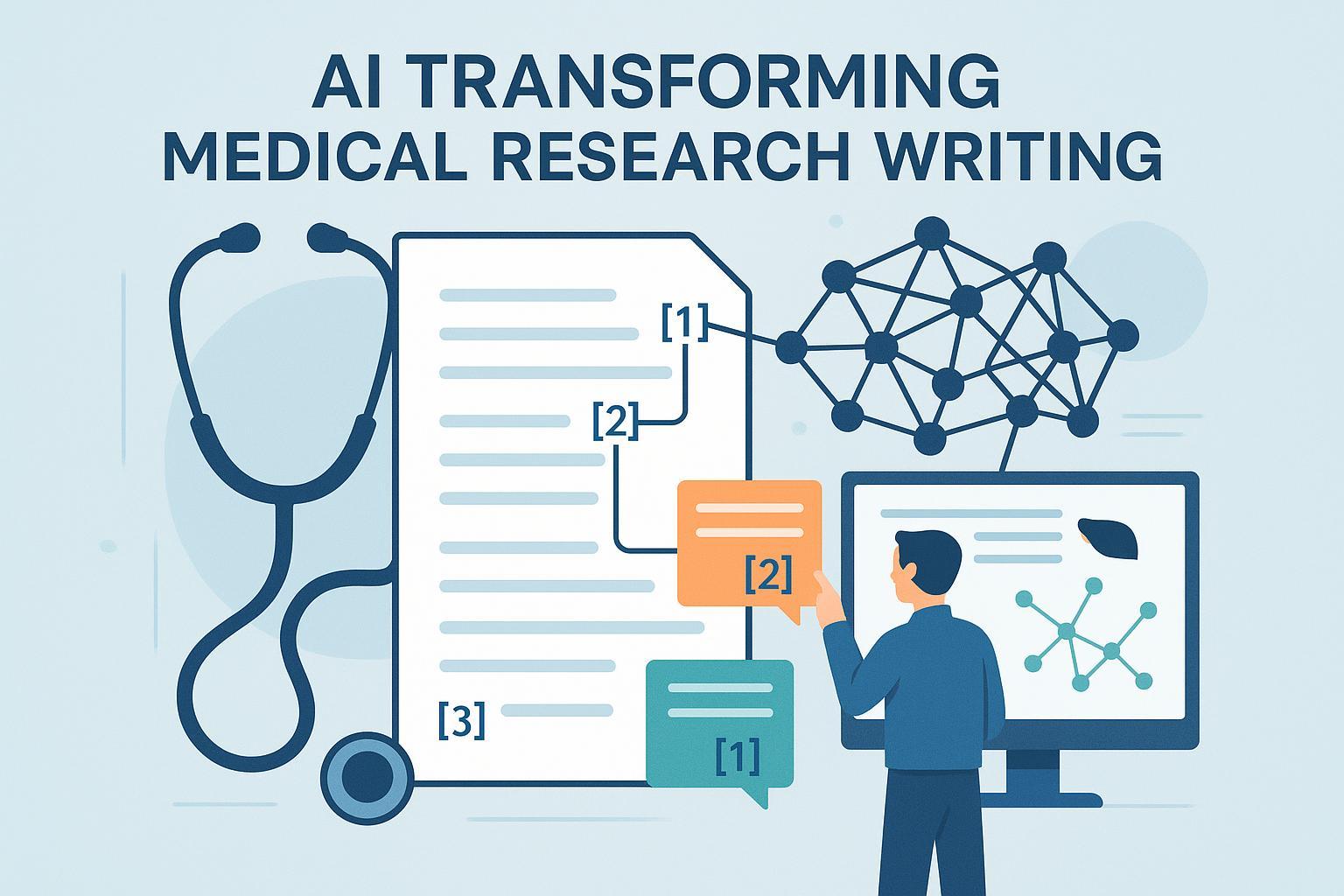
AI assistants modeled after tools like ScholarAI, Elicit, Consensus, Scite, ResearchRabbit, and Connected Papers are reshaping how biomedical researchers search, synthesize, and draft. Retrieval-augmented generation, citation-context analysis, and literature mapping can compress hours of manual work into minutes. In medicine—a "Your Money or Your Life" domain—this speed must be balanced with rigorous verification, transparent disclosures, and human accountability. Here’s how the workflows are changing, what risks remain, and how to use these tools responsibly in 2025.
What’s actually changing in medical writing workflows
- Discovery is moving from keyword-only searches to question-driven retrieval that surfaces study snapshots and structured filters (date, design, citations).
- Citation reliability can be stress-tested using smart-citation systems that show whether a claim is supported, contradicted, or merely mentioned.
- Literature relationships are visualized through graphs that reveal prior works and derivative lines of inquiry, helping authors avoid narrow or outdated bibliographies.
- Drafting assistance is increasingly used for structure, clarity, and style; however, all claims must trace back to verified primary sources, with humans responsible for accuracy and ethical compliance.
Policy guardrails are tightening. In January 2024, the International Committee of Medical Journal Editors reiterated that authors must disclose AI-assisted technologies used in manuscript preparation and that AI cannot be listed as an author, with additional cautions for peer review confidentiality according to the ICMJE Updated Recommendations (2024). The U.S. National Institutes of Health prohibits reviewers from using generative AI to analyze or formulate critiques for grant applications, as set out in NIH Notice NOT-OD-23-149 (2023).
An evidence-centered workflow that reduces risk
A practical, audit-ready loop pairs retrieval, mapping, and drafting tools with citation-context vetting and human appraisal:
- Frame your clinical or methodological question (e.g., PICO) and eligibility criteria. Decide inclusion/exclusion rules before any AI-assisted screening.
- Use retrieval tools to assemble candidate sources; export bibliographic data to your reference manager. Avoid importing any AI-generated references that lack persistent identifiers.
- Run citation-context checks in a smart-citation system and label evidence as supporting, contradicting, or mentioning. Flag weak or contradictory findings for explicit discussion.
- Draft with AI for structure and readability only. Insert in-text citation placeholders after confirming the primary source details (authors, year, DOI, outcomes) yourself.
- Human critical appraisal: reproduce key statistics, verify study designs and endpoints, check guideline alignment, and confirm recency and relevance to your question.
- Document tool usage (names, versions, and roles) and add disclosure text per journal policy. Do not upload sensitive or unpublished data to public tools; follow privacy safeguards like those emphasized in the FASEB Generative AI recommendations (2025).
Why this loop matters
Peer-reviewed evaluations and journal policies underscore that AI is not yet reliable enough to automate scientific judgment. For example, in 2024 Nature Medicine reported that large language models are not ready for autonomous clinical decision-making and highlighted risks such as diagnostic inaccuracies and guideline non-adherence, as discussed in the Nature Medicine evaluation (2024). This is a reminder that AI drafts are starting points; verification and human accountability remain paramount.
Accuracy risk management: quantify, then mitigate
Reference hallucinations and mis-citations are the most visible failure modes in AI-assisted writing. A 2024 study in the Journal of Medical Internet Research found markedly different hallucination rates across models, including 28.6% for GPT‑4 when asked to generate references, underscoring the need for manual verification and primary-source checks, per the JMIR reference hallucination analysis (2024).
Practical mitigations you can apply now:
- Source pinning: Every claim is tied to a verified primary source (full citation details checked). Avoid relying on AI-generated bibliographies.
- Citation-context vetting: Use a smart-citation tool to identify whether a paper truly supports a claim and to surface contradictory evidence for balanced discussion.
- Reference manager consistency: Normalize metadata (DOI, PubMed ID, study type) and lock your citation keys before drafting.
- Guideline alignment: Cross-check clinical recommendations against current society guidelines; discuss divergences explicitly.
Micro case vignette
A team drafting a methods section for a cardiology study used an AI assistant to outline statistical tests and suggested references. On review, two citations were fabricated and one real paper merely mentioned the test without validating it in the target population. The team replaced the AI-suggested list with verified sources, used a smart-citation tool to confirm “supporting” context, and added a paragraph acknowledging the existence of contradictory findings in older cohorts. The final draft passed editorial pre-check with a clear disclosure of tool use.
Policy compliance: a checklist for manuscripts and pre-submission reviews
- Disclosure placement: State AI tool names, versions, and roles; include in Methods or Acknowledgments according to the ICMJE Updated Recommendations (2024). Do not list AI as an author.
- Peer review boundaries: If you are a reviewer or editor, do not use generative AI to analyze or write critiques of submissions; this violates confidentiality norms per NIH Notice NOT-OD-23-149 (2023). Journals may impose similar restrictions.
- Privacy and data protection: Do not upload sensitive or unpublished data to public AI systems. Follow institutional policies and the privacy cautions highlighted by the FASEB Generative AI recommendations (2025).
- Publisher policies: Check journal portals for AI-specific author instructions. For example, Elsevier clarifies disclosure requirements and authorship limits in its Generative AI policies for journals (2025).
Role-specific guidance
- Researchers and clinician–scientists: Use AI for literature triage and drafting structure but maintain a strict verification loop. Document tool roles, and retain an audit trail (search queries, versions, decision logs).
- Academic editors: Request explicit AI-use disclosures; screen for fabricated references and ensure confidentiality in editorial workflows. Where guidelines allow, recommend citation-context vetting to authors for disputed claims.
- Research support staff (libraries/IRBs): Provide training on systematic search strategies compatible with AI tools, create local checklists aligned to ICMJE and institutional privacy policies, and maintain change-logs as policies evolve.
- Graduate students and trainees: Practice critical appraisal and manual citation verification early. Keep a lab notebook of AI prompts and decisions to facilitate reproducibility.
Communicating your research to the public: lay summaries, blogs, and briefs
Once your manuscript is verified and compliant, you may prepare public-facing summaries to reach non-specialist audiences. Keep strict boundaries: do not introduce new clinical claims that weren’t in the paper, and include clear disclaimers.
For efficient outreach workflows, consider:
- Using a structured content process like this step-by-step AI content workflow to plan, draft, and review non-technical summaries.
- Applying precise generation controls with an Extra Prompt setting to enforce terminology boundaries and require citation placeholders for later manual insertion.
- Auditing the clarity and credibility of your summary with a Content Quality Score aligned to E-E-A-T before publishing on your lab or institution site.
FAQ: common compliance questions
- Can AI be an author on a medical paper? No. Major editors make clear that AI cannot be listed as an author and that human authors retain accountability, per the ICMJE’s 2024 guidance.
- Where should I disclose AI use? Typically in the Methods or Acknowledgments section; name tools, versions, and roles, consistent with ICMJE recommendations.
- Can reviewers use AI to summarize submissions? Reviewers should not use generative AI to analyze or write critiques of confidential material, according to NIH’s 2023 notice. Journals may also restrict such use.
- Is it acceptable to rely on AI-generated references? No. Always verify primary sources and avoid fabricated or incomplete citations; JMIR’s 2024 data quantifies meaningful hallucination rates across models.
Soft note for research communication teams
If you need a simple way to produce compliant, public-facing summaries and blog posts after your manuscript is verified, you can explore QuickCreator for AI-assisted drafting, multilingual output, and on-page SEO. Disclosure: QuickCreator is our product.
Change-log
- Updated on 2025-10-06: Initial publication with policy citations (ICMJE 2024; NIH 2023), risk quantification (JMIR 2024), limits note (Nature Medicine 2024), and publisher policy example (Elsevier 2025).