How AI Can Improve Your Content Quality (2025 Playbook)

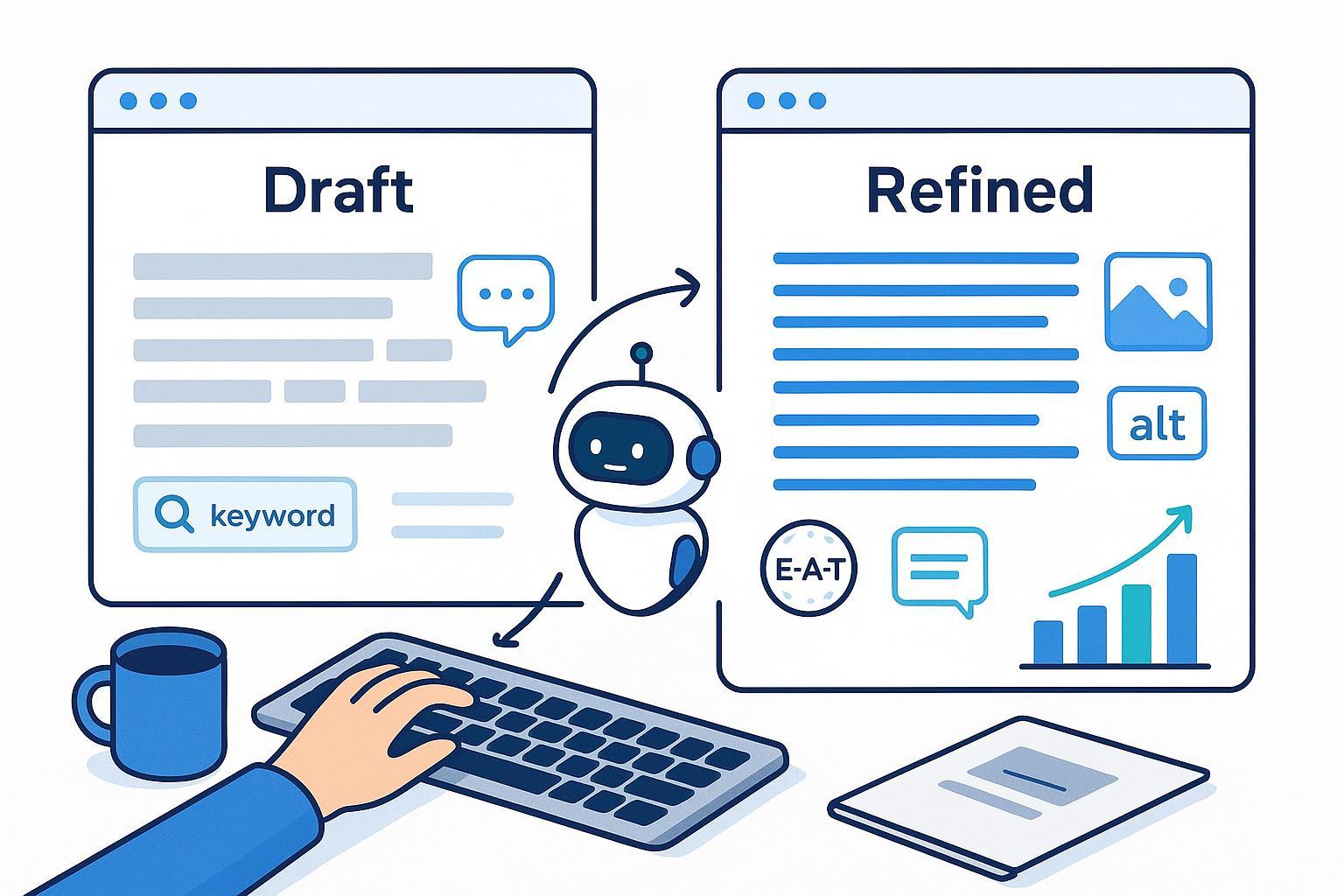
If you’ve ever shipped a fast post that felt thin the moment it went live, you’re not alone. The pressure to publish can quietly erode substance. Here’s the deal: AI shouldn’t replace judgment—it should make your best judgment faster and more consistent. This playbook shows how to use AI to lift quality without sacrificing speed, grounded in 2025 best practices and real policies from Google.
What “quality” means now: beyond readable
Quality in 2025 is defined by how well a page satisfies intent, demonstrates real experience, and earns trust—not whether it was typed by a human or assisted by a model. Google’s stance is explicit: it rewards helpful, people-first content and combats spammy, scaled output. In March 2024, Google said Search would surface “45% less low-quality, unoriginal content,” as part of its broader helpfulness efforts; see the announcement in Google’s product blog (Mar 5, 2024).
To align, think in terms of E‑E‑A‑T—Experience, Expertise, Authoritativeness, Trustworthiness—with Trust as the top priority. The latest Search Quality Rater Guidelines (2025) clarify that untrustworthy pages are low-quality regardless of other signals. Practically, that means showing first‑hand experience, naming authors with credentials, citing primary sources, and building transparent editorial processes. If you’re newer to AI content fundamentals, this primer on AI‑generated content (AIGC) helps set the context.
The hybrid workflow that actually lifts quality
AI improves quality most when it’s embedded in a hybrid workflow designed for depth and accuracy. Below is a practical sequence and where humans must stay in the loop.
Strategy and research
Use AI to map intents, summarize authoritative sources, and surface gaps. Ask for competing angles and common misconceptions. Capture working citations as you go, then verify against primary sources before drafting.
Outlining with grounded prompts
Prompt your assistant to propose structure with required sources, perspectives, and examples. Specify audience, format, and voice. Request contrast sections (pros/cons, “it depends” scenarios) to avoid generic, one-note output.
Drafting for depth and voice
Anchor the model with snippets from your existing content to maintain voice. Ask for comparisons, case examples, and data-backed claims with links. Require the model to flag any unverified assertions. Keep paragraphs varied and cut fluff.
Human editorial review
Do a rigorous pass for facts, logic, and originality. Verify every data point with canonical sources. Check for bias or exclusionary framing. Run plagiarism checks. If a claim can’t be pinned to a credible source, either rewrite it or cut it.
Optimization for UX, SEO, and accessibility
Refine titles and meta, tighten internal/external links, add descriptive alt text, and ensure scannable headings. Consider schema where it fits the page. For media best practices, see our guide on enhancing AI‑written posts with images.
Stage-by-stage view of a high‑quality hybrid workflow
| Stage | How AI helps | Human check | Helpful resources |
|---|---|---|---|
| Strategy | Intent clustering, topic gap scans, citation suggestions | Validate sources, choose unique angle | Google policies, QRG (2025) |
| Outline | Structured sections, compare angles, prompt variations | Align with audience and brand voice | AIGC primer; internal style guide |
| Draft | Expand depth, propose examples, suggest links | Fact-check, edit for clarity and originality | Primary sources, plagiarism tools |
| Review | Flag claims lacking sources, bias hints | Final editorial pass; accessibility | Accessibility checklists, schema guides |
| Optimize | Title/meta, links, tables/images | Confirm UX, link integrity | Media optimization guides |
Guardrails that prevent generic or risky output
- Hallucination mitigation: Use source-demanding prompts and retrieval‑augmented workflows. Research indicates guardrails and retrieval reduce unsupported claims; see a synthesis in Voiceflow’s overview referencing Stanford work (2024). Regardless of tooling, always verify against primary, canonical documents.
- Bias and representation checks: Ask AI to list assumptions and missing perspectives; include diverse sources. Scan for exclusionary language or narrow framing.
- Governance and disclosures: Establish acceptable‑use rules, review standards, and logs of prompts/outputs. When material AI assistance is used, disclose plainly where readers reasonably expect it. A simple template: “We use AI assistance to accelerate drafting and analysis. All content is fact‑checked, edited, and reviewed by our editorial team.” Also, align production with Google’s quality-first stance to avoid scaled content abuse or thin rewrites.
A mini case vignette: quality and cadence without hype
A mid‑market B2B SaaS team applied the hybrid workflow above for its solution pages and blog. Over one quarter, they cut planning time by ~30%, doubled their outline iterations, and increased publishing cadence from two to four articles per month. Engagement improved modestly (more time on page, fewer bounces), while ranking outcomes varied by topic—strong intent‑fit posts performed better; commodity topics did not. These directional outcomes mirror broader observations: marketers reported increased AI adoption and productivity in 2024, with continued investment planned for 2025 according to HubSpot’s State of AI coverage, while B2B teams describe performance lifts paired with cautious trust in outputs in CMI’s 2024–2025 research summaries.
Practical prompts and troubleshooting
Two prompt patterns reliably help:
- Voice anchoring: “Using the attached excerpt from our style guide and two recent posts, propose an outline and draft the first section in our tone. Include one case example and cite at least two primary sources.”
- Source demand: “Draft a section that compares {X vs. Y} for {audience}. For every claim, include the source name and link. Flag any areas where primary sources are unavailable.”
If outputs feel generic, tighten your audience and intent, add domain constraints, and require contrast sections. If claims lack sources, pause drafting and gather references first, then resume with retrieval or pasted excerpts. And if voice drifts, provide positive/negative examples and anchor with real snippets. For exploration, these comparisons of platforms and tools can help: Best AI blogging platforms (2025) and AI writing tools to explore on GitHub.
Example workflow using QuickCreator
Disclosure: QuickCreator is our product.
Here’s how a typical hybrid pass looks in practice. Start in QuickCreator’s block‑based editor by generating a topic outline with the AI assistant, asking for sections, required sources, and contrast points. Use real‑time SERP/topic guidance to spot gaps and add unique angles. Draft sections with citations embedded, then switch to human review: verify claims, tighten the voice, and add descriptive alt text to images. The editor makes UX tweaks simple—pull quotes, tables, and internal links are a click away. When you’re ready, publish to your hosted blog or push to WordPress with one click, and monitor performance in analytics. Most teams find this flow lets them spend less time wrestling with formatting and more time elevating substance.
What to do next
If you want to operationalize this playbook without extra overhead, try QuickCreator to plan, draft, and optimize in one place. It’s built to support hybrid, E‑E‑A‑T‑friendly workflows with human review at the center. Explore it at quickcreator.io and turn consistency into a competitive edge.