Using AI to Identify Content Gaps: A 2025 Playbook for SEO and Content Teams

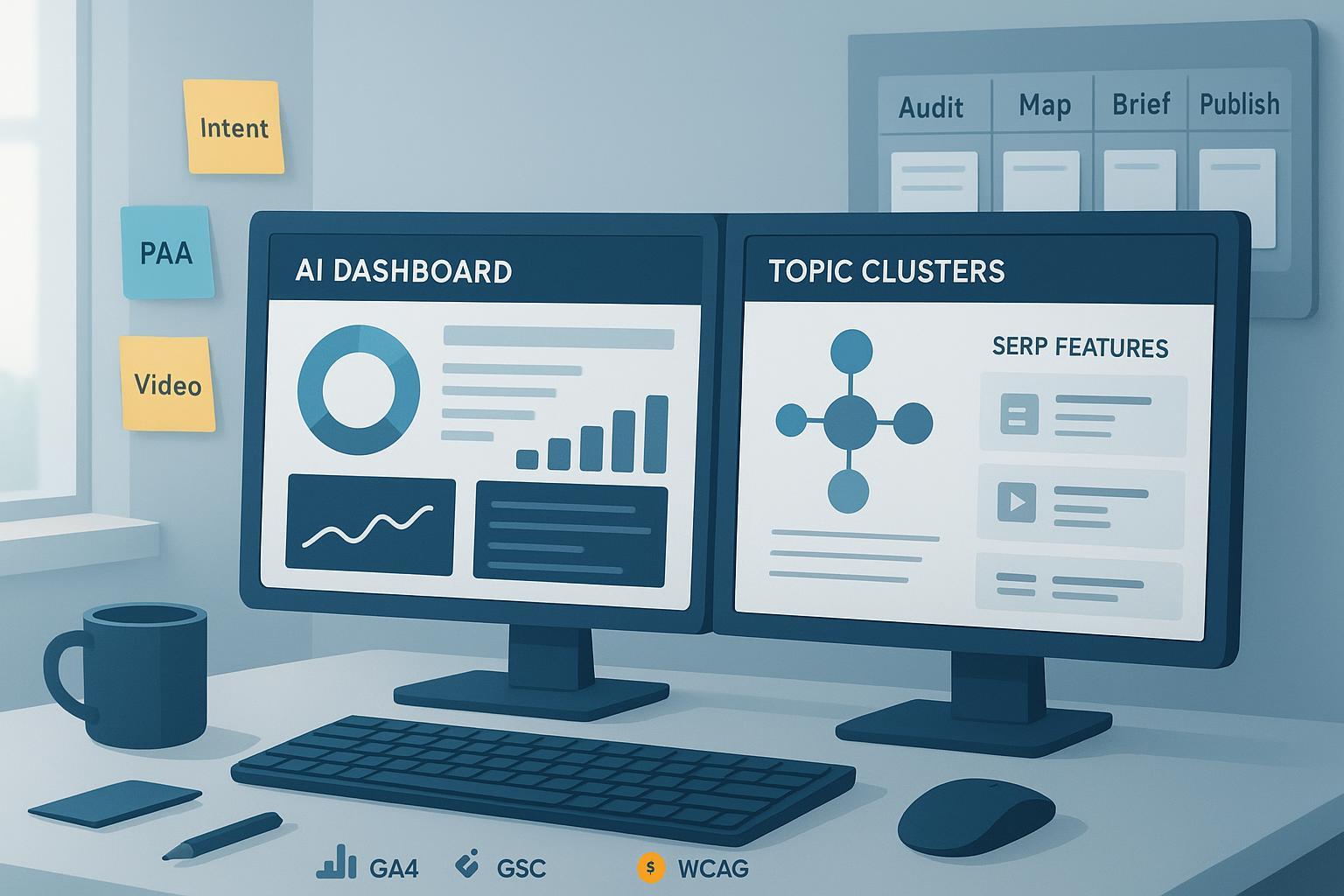
If your organic growth feels stuck, you’re probably not missing keywords—you’re missing answers. The biggest wins in 2025 often come from spotting where your content doesn’t meet user intent or SERP expectations and closing those gaps fast. How do we make that repeatable without drowning in spreadsheets?
Here’s the deal: AI can do the heavy lifting—surfacing topics, clustering queries, summarizing SERP features, and drafting briefs—while your team provides judgment, brand voice, and accuracy. Below is a practical, evidence-based workflow we’ve used across SEO programs to find and fix gaps reliably.
The end-to-end workflow (audit to action)
Step 1: Audit your library
Export your pages, impressions, queries, and engagement from Google Search Console and GA4. Group content into topic hubs and identify thin, outdated, or intent-misaligned pages. Google’s documentation recommends JSON-LD for structured data and reminds us that markup must reflect on-page content; structured data itself isn’t a ranking signal, but it improves rich result eligibility according to Google Search Central’s structured data intro and policy notes.
- Look for hubs where impressions rise but CTR stays low—often a sign of format or snippet gaps.
- Flag cannibalization: multiple pages targeting the same intent can confuse search engines and readers.
- Document freshness needs by last updated date and query volatility.
Step 2: Competitor and intent mapping
Run keyword/content gap reports to find queries competitors rank for that you don’t, then cluster by SERP similarity and map each cluster to a clear intent. Semrush frames gap analysis as discovering topics your site hasn’t covered or can improve to win visibility, with step-by-step workflows in Semrush’s content gap guide (2025). Backlinko’s hub explains practical clustering and prioritization in Content Gap.
Bring in your own signals: internal site search, sales FAQs, and support logs reveal user-voiced needs your content missed. Tag each candidate topic with funnel stage (awareness, consideration, decision) and business value (lead, sign-up, revenue influence).
Step 3: SERP feature gap analysis (AI Overviews-ready)
For each target query, note which features dominate: featured snippets, People Also Ask, video/image packs, community discussions (Perspectives), Top Stories, shopping, and more. Industry recaps from Search Central Live suggest Google keeps amplifying diverse media and UGC; see the Conductor 2025 recap. Align formats and markup accordingly. If snippets matter, test whether a concise, direct answer in the first 100–150 words improves eligibility. For products, follow Google’s Product structured data to support richer displays.
Disclosure: QuickCreator is our product.
A neutral workflow example: After clustering queries for “AI content gap analysis,” we created a Q&A section to target PAA, embedded an explainer video when video packs were frequent, and added descriptive alt text to images. A platform like QuickCreator can streamline this by drafting briefs that specify “snippet-ready paragraph,” “FAQ schema section,” and “video transcript checklist,” which your editors then humanize and fact-check before publishing.
Step 4: AI briefs and prioritization
Use AI to assemble brief packages: topic summary, target intents, competitor notes, SERP features, outline, sources to consult, and schema suggestions. Rank the opportunities with a simple matrix that blends potential impact with effort. Tools overviews note that AI briefs and NLP clustering are core features across MarketMuse, Surfer, Clearscope, and others; see Rankability’s 2025 roundup.
Humanize and verify every brief. Assign a subject-matter reviewer, run factual cross-checks, and add author bios and citations. Google’s guidance is clear that AI-assisted content is fine if it’s useful, accurate, and reviewed by humans—see the SEO Starter Guide.
Step 5: Governance: human-in-the-loop, NIST-aligned controls
Build guardrails so AI accelerates work without compromising trust. The NIST AI Risk Management Framework emphasizes human oversight, traceability, and bias checks; adopt checkpoints where editors verify claims, intent alignment, and sources. Trust Insights outlines practical human-in-the-loop controls—accuracy verification, expert review, and audit trails—in their 2024 guidance.
- Require a reviewer to sign off on low-confidence segments.
- Keep an audit log of changes and reasoning for major content decisions.
- Document policies for disclosure, data privacy, and vendor risk.
Step 6: Measure impact and iterate
Track rankings, rich result appearances, CTR, conversions, and engagement by hub and page. Refresh content based on performance and changing SERP features. McKinsey’s technology trend outlook highlights marketing/content as a major area of productivity gains from generative AI; use that upside to justify ongoing iteration and capability building—see McKinsey’s Technology Trends Outlook (2024 PDF).
Building a practical prioritization matrix
A quick matrix helps you pick battles wisely. Score each opportunity on intent fit, SERP feature potential, business value, and effort.
| Opportunity | Intent Fit (1–5) | SERP Feature Potential (1–5) | Business Value (1–5) | Effort (1–5) | Priority Score |
|---|---|---|---|---|---|
| “AI gap analysis checklist” article | 5 | 4 | 4 | 2 | 5.5 |
| “Video explainer” for core hub | 4 | 5 | 3 | 3 | 4.5 |
| “Multilingual localization guide” | 4 | 3 | 5 | 4 | 4.0 |
Priority Score formula: (Intent Fit + SERP Potential + Business Value) ÷ Effort.
Advanced techniques to close gaps faster
Topic clustering and internal linking
Cluster terms by SERP similarity and co-occurrence to build topic hubs. Use semantic anchors and descriptive internal links to guide users and crawlers. Backlinko’s hub provides practical tactics in Content Gap.
Schema and rich results alignment
Use JSON-LD and keep markup truthful to page content. Monitor Google’s updates to avoid deprecated types and maximize eligibility for rich results. Align content sections with potential features—FAQs for PAA, how-tos with clear steps, product details with reviews and availability.
Accessibility and readability (WCAG 2.2)
Your content isn’t complete if some users can’t consume it. WCAG 2.2 became an ISO/IEC standard in 2025; prioritize focus appearance, target size, descriptive link text, alt text, captions, and keyboard operability. The W3C announcement offers context in WCAG 2.2 ISO/IEC news (2025).
Multilingual execution and localization
Localize topic clusters by market. Combine AI-assisted translation with human QA to preserve idioms, regulatory phrasing, and search behavior per locale. For practical context on how multilingual content affects share of voice in generative search, see Localazy’s overview.
Pitfalls to avoid
- Treating AI outputs as finished content instead of drafts to be reviewed.
- Optimizing blindly for keywords while ignoring intent and SERP features.
- Skipping accessibility and schema—both reduce discoverability and usability.
- Overproducing near-duplicates, causing cannibalization and thin-content issues.
A condensed checklist you can copy
- Audit hubs in GSC/GA4; flag thin, outdated, low-CTR pages.
- Map competitor gaps; cluster by SERP similarity; assign intents and funnel stages.
- Analyze SERP features; add format-ready sections (snippet-ready answers, FAQs, video transcripts, alt text).
- Generate AI briefs; humanize, fact-check; add author bio and citations; implement schema.
- Establish human-in-the-loop checkpoints; maintain audit logs; disclose AI/tool use when relevant.
- Track rankings, CTR, rich results, conversions; refresh on a set cadence.
For deeper guidance on structuring clear sections and paragraphs, see our internal resource on clarity: Exploring Umbrella Paragraphs: A Comprehensive Legal Writing Handbook Tutorial.
Next steps
If you’re ready to operationalize this, pilot the workflow on a single hub: one audit sprint, one SERP feature alignment pass, three briefs, and a 30-day measurement plan. A platform like QuickCreator can centralize briefs, schema suggestions, and collaboration while your experts keep quality high—evaluate it alongside your current stack and choose what fits your process.