How Agencies Should Price AI Blog Writing Services in 2025

If your pricing for “AI blog writing” is just a cheaper per‑word rate, you’re leaving money on the table—and inviting quality problems. Buyers aren’t paying for tokens; they’re paying for outcomes, editorial rigor, and the operational reliability to scale without risking their brand.
Budgets are holding or rising even as scrutiny intensifies. In enterprise cohorts, 39% expect content budgets to increase and 41% expect them to hold steady, according to the Content Marketing Institute’s Enterprise Content Marketing Research (2025). The opportunity for agencies is clear: package hybrid AI+human workflows transparently, price against defendable unit economics, and link premium tiers to measurable business impact.
The pricing models that actually work now
Here’s the short list of models that make sense for AI-assisted blog production—and when to use each.
- Per article or per word: Good for simple scopes and low-friction buying. In many 2025 agency contexts, AI-assisted mid-market posts land around $100–$300 per ~1,500 words when they include AI drafting plus real editing and SEO polish, with higher ranges for complexity—as seen in agency-side guidance like Flying V Group’s 2025 pricing models overview. Use this when deliverables are uniform and briefing is standardized.
- Retainers/subscriptions: Best for predictable volume and compounding SEO strategy. Bundle editorial planning, briefs, optimization, and reporting. Offer stepped discounts at volume but keep guardrails around revision scopes and SME time.
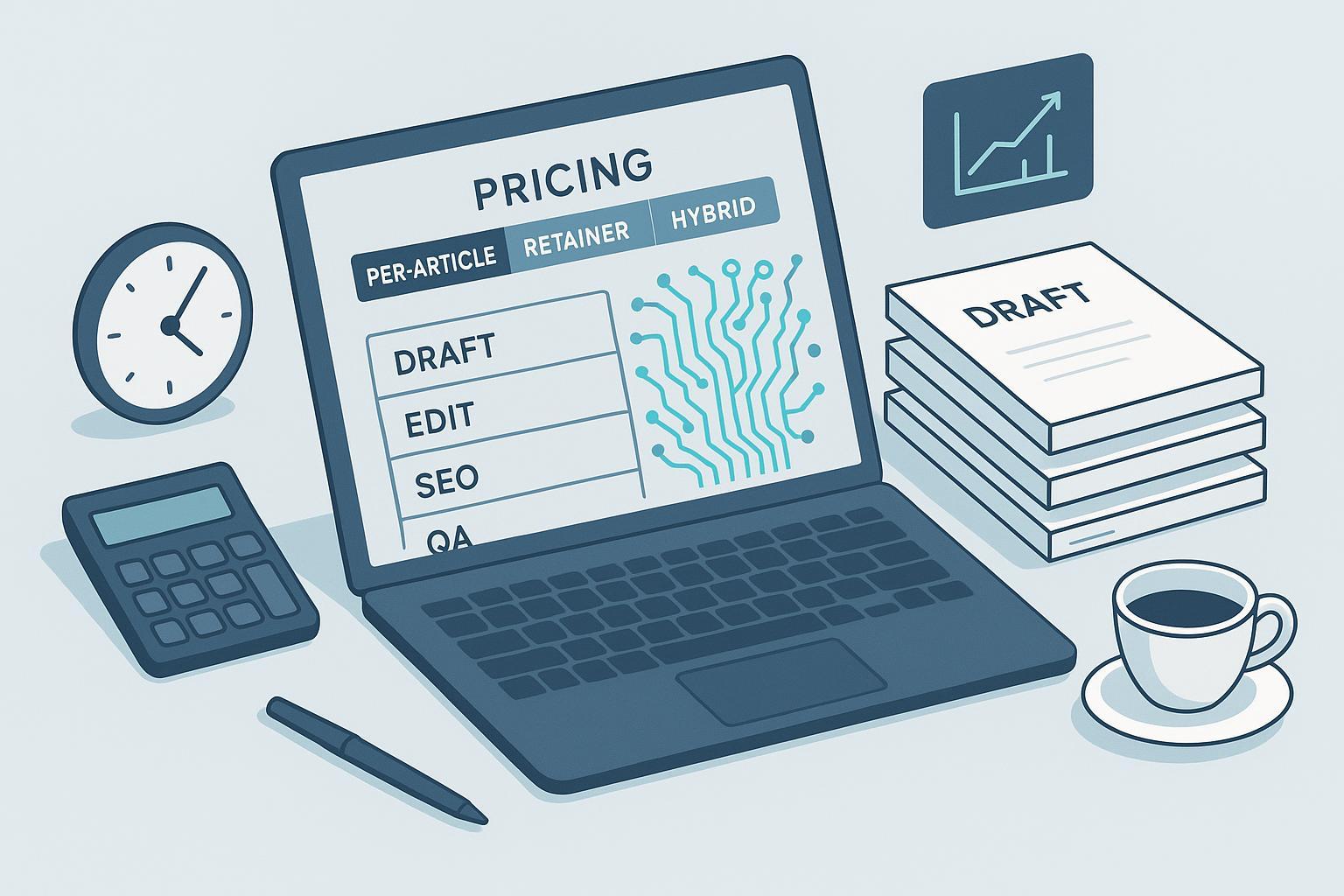
- Hybrid packages (AI draft + human editing + SEO + QA): The default for most serious brands. Make the human layers explicit: line edit, fact-check, on-page SEO, internal links, images, and voice alignment. Price rises with subject complexity and compliance.
- Value- or outcome-linked tiers: Appropriate when clients want rankings, qualified traffic, or pipeline influence tied to fees. Structure carefully (see below) to avoid unbounded risk and algorithm whiplash.
Unit economics you can defend
Think of your price floor like a sturdy foundation: it’s poured from hours, tools, and a small layer of AI compute.
- Human time dominates. For a 1,500–2,000-word hybrid post, agencies typically log 3–7 hours end-to-end (briefing, AI prompting, editing, SEO, SME review, publication). U.S. 2025 market rates for editors commonly sit in the $40–$100/hour band depending on depth, per the Editorial Freelancers Association’s rate guidelines (2025). Blend in strategist/SME time for complex topics.
- Tool stack is amortized. SEO optimization and writing QA platforms (e.g., Clearscope/Surfer), grammar, plagiarism checks, analytics—budget a per-post share based on retainer size and seat count.
- AI compute is pennies. As an example, Anthropic lists Claude 3.5 Sonnet at roughly $3 per million input tokens and $15 per million output tokens; a 2,000-word draft might cost only a few cents in generation fees. See Anthropic’s Claude 3.5 Sonnet pricing (2024–2025) for current reference.
Do the math. If your blended human time is 4.5 hours at $75/hour ($337.50), tools amortize to ~$10/post, and AI compute is ~$0.05, your floor is ~$347.55. From there, add overhead and target margin, then adjust for complexity and value.
A practical pricing matrix (illustrative)
These indicative ranges assume hybrid workflows with real editing, on-page SEO, and basic images. Adjust for your team’s rates, niche complexity, and compliance.
| Scenario | Scope highlights | Indicative price (per post) | What moves the price |
|---|---|---|---|
| SMB blog, low complexity | Brief + AI draft + line edit + on-page SEO + image | $150–$250 | Volume, minimal SME time, light fact-checking |
| B2B mid-market, technical light | Brief + AI draft + substantive edit + internal links + image set | $250–$450 | Keyword difficulty, link architecture, requested revisions |
| Regulated or deep technical | Brief + AI draft + SME review + citations + compliance pass | $450–$900 | SME hours, legal review, footnotes/citations, accuracy guarantees |
| Thought leadership series | Interview-based brief + AI assist + senior editor + distribution brief | $600–$1,200 | Executive time, originality depth, design assets, promotion |
Tip: Publish ranges by tier and define exactly what’s included at each level. That’s how you prevent scope creep and build trust.
How to quote, step by step
- Clarify scope and outcomes: Topics, length ranges, SEO goals, required sources, voice samples, revision limits, and who supplies subject expertise. Align on success metrics (rankings, impressions, leads) even if they’re not tied to fees.
- Estimate hours and select the tier: Use your own historicals. For new verticals, pad for research and voice calibration. Map the work to the matrix above to avoid underbidding.
- Add margin and guardrails: Layer in overhead and profit, then lock guardrails in your SOW—revision rounds, SME caps, turnaround SLAs, and what triggers change orders. Offer volume discounts only when workflows are stable and briefs are batched.
Value- and outcome-linked options (with risk controls)
Clients will ask, “Can you price against results?” You can—carefully. Here’s the deal: price a base production retainer, then add a performance component with clear definitions.
- Goals and measurement windows: Tie bonuses to agreed KPIs (e.g., top‑10 rankings on a prioritized keyword set within 120 days; MoM growth thresholds in non‑brand organic clicks). Cite external factors and seasonality in the assumptions.
- Exclusions and floors: Exclude force majeure (major algorithm updates), site outages, dev delays, and content outside your control. Maintain a minimum base to cover production costs.
- Evidence plan: Instrument the work. Google’s March 2024 update targeted scaled, low‑value content and spam tactics; your QA and authorship standards are part of the value. See Google’s March 2024 core update and spam policies for context.
Proof it can work? Hybrid content plus sound SEO mechanics can drive real outcomes. SE Ranking reported that a small batch of AI‑assisted posts generated 555K+ impressions and 2,300+ clicks over ~13 months in their AI content experiment (2024–2025)—with the caveat that human oversight and moderation matter.
Contracts, compliance, and rights you shouldn’t skip
- Authorship and IP: U.S. law requires human authorship for copyright. Document human creative contribution (briefs, edits, structure) and grant IP accordingly. See the U.S. Copyright Office’s “Copyright and Artificial Intelligence—Part 2: Copyrightability” (2025).
- Warranties and indemnities: Originality, rights to all assets, and compliance with search and advertising policies. Include reasonable caps.
- AI-use disclosure and data governance: Specify allowed models, no-training clauses for client data, and confidentiality. Regulated clients may require model/version pinning and data residency notes.
Negotiation playbook and client education
A calm, confident script beats a discount.
- Anchor on outcomes and risk mitigation: “Our pricing reflects senior editing, citations, and QA that keep you on the right side of Google’s policies and brand safety.” If needed, reference Google’s guidance (2024) to illustrate why quality layers matter.
- Offer options, not concessions: “Here are two packages at different QA depths. If we remove SME review, the price drops by $X, but so does accuracy accountability.”
- Reframe per‑word objections: “Per‑word pricing incentivizes bloat. We price the strategy, accuracy, and performance architecture—not syllables.”
A simple rate card template you can adapt
Copy, customize, and publish. Update quarterly as models, tools, and costs evolve.
- Essential (AI‑assisted): $180–$280/post (~1,200–1,600 words). Includes brief, AI draft, line edit, on‑page SEO, stock image. Up to 1 revision. 5–8 posts/mo: 5% discount.
- Professional (hybrid + SME touch): $300–$520/post. Adds substantive edit, internal linking, light SME review (30 min), and 2 revisions. 6–12 posts/mo: 8% discount.
- Premium (regulated/lead‑driving): $600–$1,100/post. Adds SME review (60–90 min), citations, compliance pass, schema brief, and distribution checklist. Optional outcome‑linked bonus model.
Footnotes and references to keep handy when clients ask “why”: market unit economics and policy realities. For context on labor rates, point to the EFA’s 2025 editor rate ranges. For compute minimalism, reference Anthropic’s published model pricing. For legal authorship boundaries, cite the USCO 2025 report. And to ground your ROI story, keep a case or two like SE Ranking’s AI experiment results (2024–2025) in your back pocket.
Final thought
Publish your tiers, define every deliverable, and tie premiums to the layers that reduce risk and move needles: strategy, SME time, QA, and measurement. Then revisit pricing quarterly. Markets shift; your value story shouldn’t.