How AI Helps Agencies Improve Client Retention

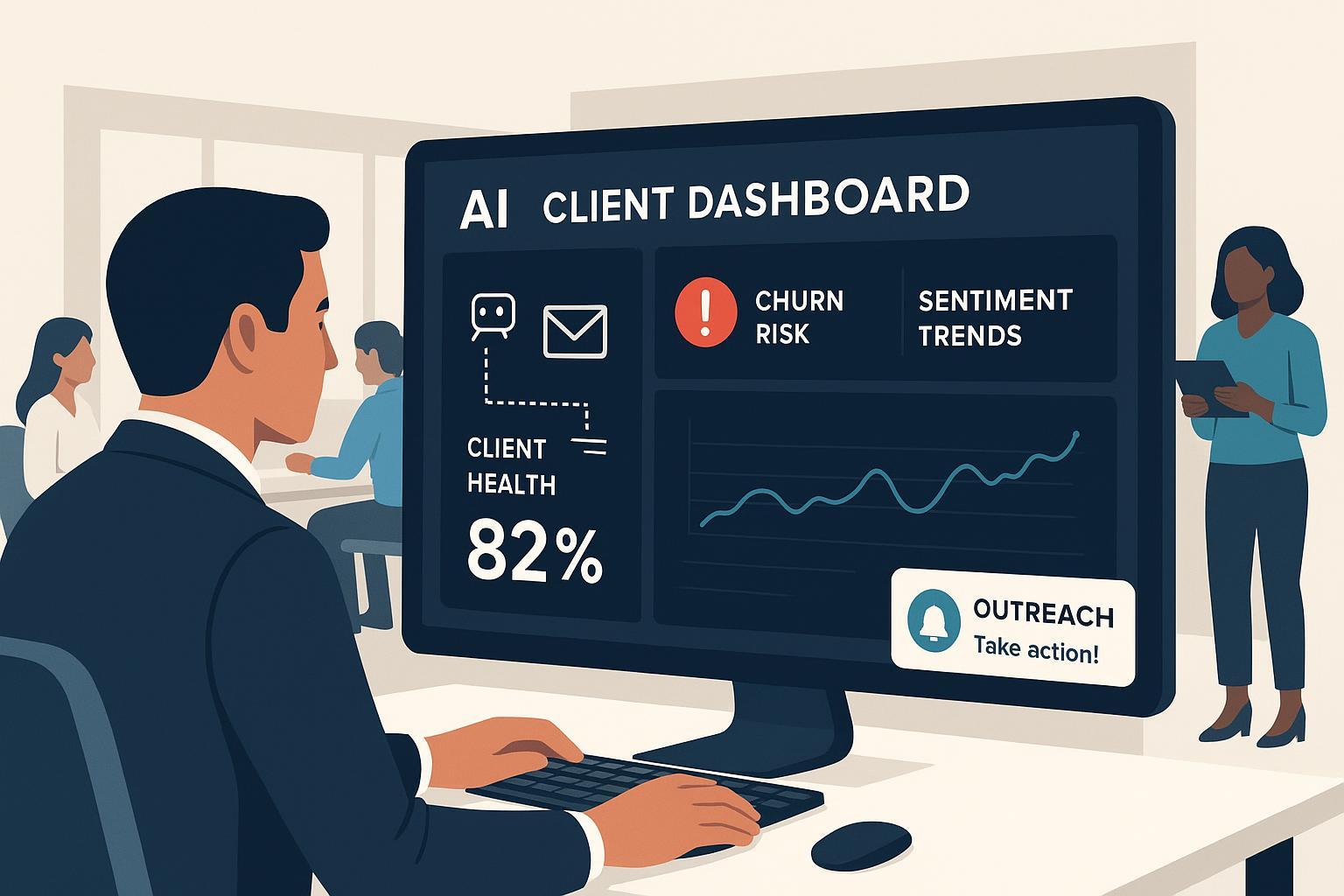
If retaining good clients feels harder than winning new ones, you’re not imagining it. Expectations are higher, budgets are scrutinized, and tolerance for slow, generic service is thin. Here’s the deal: agencies using AI to spot risk early, personalize service, and respond faster are widening the retention gap—often with measurable gains in CSAT, lower cost-to-serve, and steadier renewals. According to McKinsey’s 2025 analysis of next-best-experience programs, AI-orchestrated personalization has driven 15–20% CSAT lifts, 5–8% revenue gains, 20–30% cost-to-serve reductions, and up to a 20% attrition decrease in a global payments example. See McKinsey’s report on how AI can power every customer interaction (2025) for details.
What “AI for retention” really means for agencies
AI for retention isn’t one tool; it’s a capability stack. It scores risk and opportunity across accounts, personalizes interactions by role and intent, listens to sentiment at scale across tickets and transcripts, automates routine tasks, assists humans in complex conversations, and does all of this with explainability and guardrails. When these layers work together, time-to-resolution drops, first-contact resolution rises, and at-risk stakeholders get proactive outreach. Real-world service examples from Zendesk in 2025—like resolution-time reductions over 90% and sizable CSAT lifts—show the operational improvements that correlate with renewals.
The Agency Retention Framework (Six Pillars)
1) Data readiness and governance
Strong retention programs start with clean, connected data. Unify CRM, PM/delivery, support, analytics, and billing around a shared account_id; tag PII; and implement quality gates (dedupe, missingness handling, drift checks). Apply privacy-by-design: collect only what you need, record consent, and document your profiling purpose. If you serve EU clients, plan for EU AI Act obligations that phase in from 2025–2026; align with ISO 27001/27701 and maintain DPAs that clarify AI processing and audit rights.
2) Predictive churn and health scoring
Use supervised models to rank risk (logistic regression or gradient boosting) and survival analysis (Cox/AFT) when you need “time to churn” under varying contract terms. Start with features you already have: adoption depth, session frequency, support volume and sentiment, payment signals, contract term, and engagement with content and QBRs. Target AUC ≥ 0.75; track lift in top deciles; and use SHAP to expose drivers so account teams can act. For a practical survival-analysis primer specific to churn, Fabi.ai’s 2024 guide is a solid starting point.
3) Personalization across onboarding, delivery, and renewal
Think of AI as a dynamic concierge. During onboarding, adapt checklists and tutorials to each stakeholder’s role and goals. During delivery, surface next-best-actions to account managers and generate QBR drafts that spotlight the outcomes each executive cares about. Near renewal, sequence personalized offers and adoption sprints based on risk and value. McKinsey’s NBX findings help explain why this orchestration drives CSAT and reduces churn.
4) Sentiment analysis and Voice of Customer feedback loops
Aggregate NPS/CSAT/CES, tickets, chats, call transcripts, surveys, and public reviews. Use sentiment and topic modeling to detect friction early, route rescues to the right owners, and feed learnings back into playbooks and training. Calabrio’s 2025 VoC overview summarizes common capabilities and workflows for building these loops.
5) Omnichannel automation and agent assist
Use AI agents to deflect repeatable questions, triage accurately, and bring full context into conversations. Pair that with agent assist to summarize, suggest responses, and enforce tone and compliance. The goal isn’t to remove people—it’s to free them for relationship work and targeted interventions. Zendesk’s 2025 examples illustrate the pattern: faster resolutions, fewer handoffs, more consistent experiences.
6) Compliance and ethical guardrails
Codify human oversight for key decisions, define escalation thresholds, and publish guidance on what your AI will and won’t do. Perform DPIAs for profiling, test models for bias, document explainability, and set retention/deletion schedules for training and inference data. Keep SCCs/TIAs in place for cross-border transfers and write explicit AI clauses into DPAs with clients.
Implementation Playbooks you can start this quarter
Playbook 1: The 90-day churn prediction and intervention loop
Phase 1: Inventory data sources, define account_id keys, and extract 6–12 months of history. Draft a minimal feature set—adoption depth, feature flags, unresolved tickets, sentiment score, days-to-renewal, payment status. Phase 2: Train a baseline gradient boosting model for risk ranking and a Cox model for time-to-churn; validate AUC and lift; inspect SHAP to confirm drivers match intuition; create three risk bands and assign next-best-actions. Phase 3: Deploy nightly scoring to your CRM; trigger adoption sprints or executive check-ins for high risk; review playbook triggers for medium risk; automate value reinforcement for low risk. Phase 4: Measure against a holdout or prior cohort—logo churn, GRR/NRR, CSAT, and time-to-resolution; then tune features, prompts, and thresholds.
Why this works: clear objectives, fast iteration, explainability, and actions tied to drivers. Quick gut check: if your top five drivers don’t suggest specific plays, your features are probably too abstract.
Playbook 2: AI‑personalized onboarding that sticks
Map personas and jobs-to-be-done across the buying committee and generate role-based checklists, success milestones, and a 30/60/90 cadence. Use AI to draft welcome sequences and explainers in each stakeholder’s language and tone, with human review gates for contractual or sensitive notes. Predict early adoption risk from day‑7 signals—non-usage of critical features, weak doc engagement, lingering tickets—and trigger a guided session or a micro‑training video. Auto‑compile a “Week 3 outcomes” note for the economic buyer that frames progress against their goals and lays out next steps.
Playbook 3: Real-time rescue with VoC alerts and agent assist
Centralize transcripts and feedback, then run weekly sentiment/topic clustering to surface themes like reporting confusion or approval delays. Set alerts so that negative sentiment combined with high LTV or fewer than 45 days to renewal pings the AM in Slack/Teams within 15 minutes and creates a task in your PM tool. Provide agent-assist suggestions with context from prior tickets, QBR notes, and contract scope, and require human approval for material commitments. Close the loop with a short pulse survey after resolution; tag the outcome to the root cause and feed it back to the knowledge base.
Metrics that matter and a quick ROI model
Focus on renewal-linked metrics: Gross Revenue Retention (GRR), Net Revenue Retention (NRR), logo churn, CSAT/NPS, first-contact resolution (FCR), time-to-resolution, and cost-to-serve. For retention math and benchmarks, Recurly’s 2025 guidance is a solid reference on GRR/NRR and CLV mechanics.
Below is a compact set of formulas with a worked example for a retainer-based agency.
| Metric | Formula | Example Inputs | Result |
|---|---|---|---|
| CLV | (ARPA × Gross Margin) / Monthly Churn | ARPA $8,000; margin 60%; churn 3% → 2% | Before: $160,000; After: $240,000 |
| CAC Payback (months) | CAC / (ARPA × Gross Margin) | CAC $25,000; ARPA $8,000; margin 60% | ≈ 5.2 months |
| NRR (monthly, simplified) | 1 + expansion – churn | Expansion 2%; churn 3% → 2% | Before: 99%; After: 100% |
Interpretation: a one-point reduction in monthly churn (3% → 2%) at $8K ARPA and 60% margin increases modeled CLV by ~$80,000 per logo and stabilizes NRR around 100%. Your numbers will vary, so rerun with your own ARPA, margin, and churn.
The human–AI balance
AI excels at scale, speed, and pattern recognition; humans win on context, trust, and negotiation. Keep people in the loop for executive stakeholder alignment, scope resets, commercial terms, high-risk rescues, and quality control of tone and commitments. A simple rule: AI drafts, humans decide and deliver anything that materially affects scope, price, or relationship. Sound obvious? In the heat of a renewal, clear boundaries prevent missteps.
Change management and team enablement
Success isn’t just about models and tools—it’s also about habits. Establish shared definitions and dashboards so everyone knows what “high risk” means and which three actions must occur within 48 hours. Provide reusable prompts for QBR drafts, adoption nudges, and sentiment-aware replies, and maintain a living playbook. Coach weekly on empathy and escalation, and reward teams for early risk detection and proactive saves, not just closed tickets. Finally, set a governance cadence for features, bias testing, and compliance artifacts (DPIAs, DPA clauses, deletion logs), and document explainability and changes over time.
Your first 30 days (a pragmatic starter plan)
- Connect data for five high-value clients; define account_id keys and a minimal feature set. Stand up a shared dashboard with risk bands and top drivers.
- Pilot one VoC alert: negative sentiment + high LTV → AM ping + task creation. Track time-to-first-response and resolution.
- Automate one onboarding sequence per persona with human review gates. Insert a day‑7 adoption check and day‑21 value recap to the economic buyer.
- Establish guardrails: write down what your AI can draft, what humans must approve, and how you’ll log decisions.
Selected sources for deeper exploration
- According to McKinsey’s 2025 analysis of next-best-experience programs, AI orchestration has driven CSAT uplifts of 15–20% and up to 20% attrition reduction in specific cases: Next best experience: How AI can power every customer interaction.
- Zendesk’s 2025 coverage documents resolution-time reductions, CSAT gains, and agent productivity improvements tied to AI agents and assist: Product updates and Resolution Platform AI agents.
- For survival analysis in churn prediction, see: Why use survival analysis for churn prediction (2024).
- For VoC program setup, review: Top VoC software tools (Calabrio, 2025).
- For retention math and core formulas, start here: How to measure customer retention and key metrics (Recurly, 2025).