Why Marketers Are Rapidly Adopting AI Automation Tools in 2025

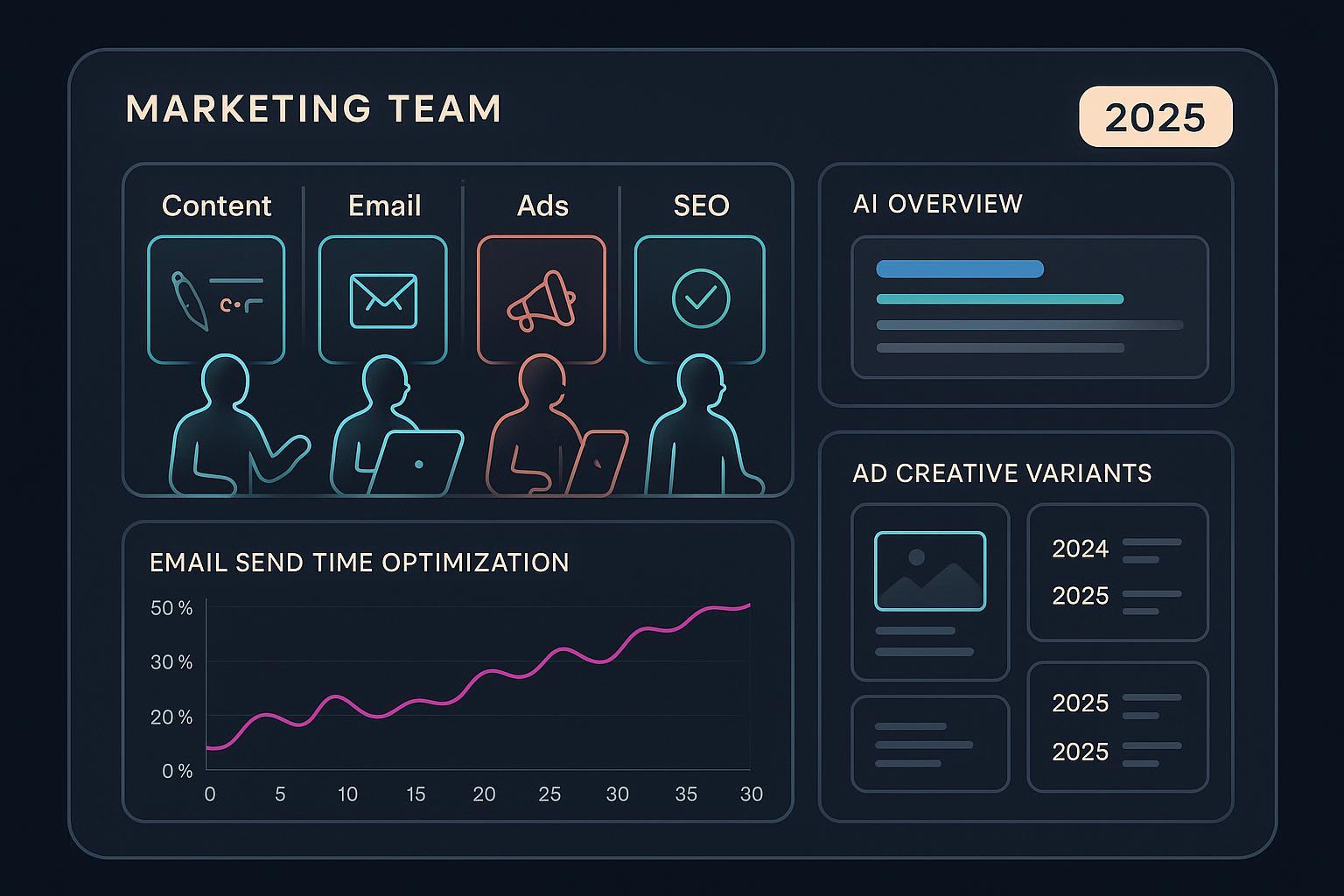
Marketing teams aren’t just “testing AI” anymore—they’re rebuilding operations around it. In 2025, agentic workflows, multimodal generation, and real-time analytics are shifting marketing from batch campaigns to continuous optimization. Budgets are holding up, early ROI is materializing in content ops, email, and creative testing, and governance expectations are getting clearer.
Why now: capability, cost, and compliance converged
- Broad adoption with maturity gaps. In a global survey published in March 2025, McKinsey reports that 78% of organizations use AI in at least one business function, while noting many still struggle to scale beyond pilots. See the McKinsey 2025 report, The state of AI (PDF) for context: McKinsey — 78% using AI in at least one function (2025).
- Feasibility is improving. Foundation models and tooling keep advancing, while inference and orchestration costs are trending down over time, enabling more always-on use cases (see the Stanford HAI AI Index 2025 for market-wide context): Stanford HAI — 2025 AI Index hub.
- Governance is no longer optional. The EU AI Act’s first rules took effect in early 2025, with prohibited practices applicable from February 2, 2025, as clarified by the European Commission’s February 2025 guidance: European Commission — Guidelines on prohibited AI practices (2025).
What this means for marketers: the path to value runs through practical workflows plus built-in QA, disclosures, and measurement—not one-off prompts.
What’s actually being automated (and where it pays off)
- Content operations
- Briefing to draft to publish: automate topic scans, outlines, first drafts, and metadata; keep humans for fact-checks, brand voice, and final sign-off.
- Localization/transcreation: scale multilingual content while preserving brand tone with human review.
- Email and lifecycle
- Send-time optimization and subject line variants informed by behavior and cohort performance.
- Triggered journeys with automated copy refresh and guardrails for claims and personalization depth.
- Paid media and creative testing
- Rapid creative iteration, headline/body swaps, and audience notes with structured experiment designs.
- Budget reallocation across ad sets based on performance signals.
- SEO and multi-surface discovery
- Generate entity-rich content supported by citations; build FAQs and snippets aligned to likely AI-generated summaries.
- Monitor how AI-shaped surfaces affect reach and clicks. In May 2025 reporting, Search Engine Land summarized third-party analyses showing that AI Overviews appeared in roughly 13% of U.S. desktop searches by March 2025, and many sites saw lower click-through when AI summaries were present: Search Engine Land — AI Overviews prevalence and clicks (2025).
- User behavior is changing. July 2025 research from Pew indicates users are less likely to click results when an AI summary appears on the page: Pew Research Center — users click less with AI summaries (2025).
Risk register (and how teams are de-risking automation)
- Hallucination and factual errors
- Controls: source-grounded prompting; mandatory citations; human editorial QA; original reporting for claims.
- Brand safety and bias
- Controls: bias checks on model outputs; reinforcement of style and DEI guidelines; escalate sensitive topics to expert review.
- SEO volatility and quality penalties
- Controls: lean on subject-matter expertise, first-party data, and authoritative citations; track entity coverage and topical depth; monitor AI-surface visibility.
- Compliance and transparency
- In the EU, avoid prohibited practices, and prepare for staged transparency obligations for general-purpose AI through 2025–2026. A September 2025 practitioner brief outlines the EU AI Act rollout and the August 2, 2025 start for GPAI transparency duties: Dentons — EU AI Act implementation timeline (2025).
- In the U.S., regulators are acting against deceptive AI marketing claims. In August 2025, the Federal Trade Commission approved an order against a company that misrepresented its AI’s accuracy—an example of truth-in-advertising enforcement that marketers should heed: FTC — Final order re misrepresented AI accuracy (2025).
For a deeper walkthrough of editorial safeguards and review points, see our guide to content workflows with human-in-the-loop.
From prompts to pipelines: agentic automation in practice
Most gains come from turning single prompts into governed, multi-step pipelines. That means:
- Orchestrating tasks (e.g., SERP/topic scan → brief → draft → fact-check → copyedit → SEO checks → publish → measure → iterate).
- Encoding QA and compliance gates where they naturally belong.
- Instrumenting each step with KPIs (time-to-publish, error rate, CTR, conversion rate, engagement).
Learn how orchestration and autonomous tasking fit together in our explainer on agentic workflows for marketers.
A neutral, replicable content ops example
A mid-market team sets up an end-to-end content pipeline that connects research, drafting, SEO checks, and one-click publishing to WordPress using an AI blogging platform like QuickCreator. Disclosure: QuickCreator is our product.
- Intake: define topic, audience, and constraints; auto-generate a brief from current SERP patterns and entity coverage.
- Draft: produce a first draft with inline source prompts; flag low-confidence facts for human review.
- QA & SEO: run editorial checks for brand voice, citations, and on-page SEO; ensure disclosure labels where AI assistance was used.
- Publish & measure: publish to WordPress; monitor impressions, CTR, and AI-surface visibility in GSC and analytics; feed learnings back into the brief template.
This same pattern applies to email (subject lines, send-time testing) and paid creative (variant generation and experiment design) with appropriate guardrails.
Segment-specific starting points
-
SMB owners and lean marketing teams
- Start with 1–2 high-yield workflows (content ops; email timing/subject testing).
- Keep the stack simple: CMS/WordPress integration, SEO checks, collaboration, and basic analytics.
- Define “done” and QA steps upfront; review weekly.
-
Performance marketers and agencies
- Prioritize creative iteration and experiment velocity; standardize variant generation and learning agendas.
- Build a playbook for disclosures and claim substantiation to satisfy client and regulatory scrutiny.
- Track AI-surface visibility; our primer on authority helps align content with evolving search: building content authority for Google’s 2025 update.
-
Mid-market/enterprise CMOs and Marketing Ops
- Treat AI as an operating model change: define governance roles, data readiness, and integration with CRM/CDP/analytics.
- Map EU AI Act expectations to marketing workflows (disclosure, record-keeping, model documentation where applicable).
- Establish a quarterly review of pipeline performance and risk logs.
Metrics that matter in 2025
Track outcome and quality, not just speed:
- Throughput and cycle time: time-to-brief, time-to-first-draft, time-to-publish.
- Quality and accuracy: editorial error rate, citation completeness, fact-check pass rate.
- Engagement and revenue: CTR, conversion rate, assisted pipeline/revenue.
- SEO and discovery: impressions, CTR across organic and AI-summarized surfaces; entity coverage, authority signals.
- Compliance and trust: disclosure rate, incident count/MTTR for corrections, substantiation logs for claims.
The search shift: evolving SEO beyond blue links
AI Overviews and similar experiences compress the click opportunity window and reward strong entities, clear citations, and topical coverage depth. Practical moves:
- Consolidate and enrich pillar pages; structure FAQs and definitions that are likely to be cited in summaries.
- Use first-party data and expert quotes to strengthen credibility.
- Monitor where and when your brand appears inside AI answers and track CTR deltas alongside organic rankings.
If you’re building a monitoring stack for AI answers, complement GSC with specialty tools; we maintain a running explainer on approaches in our overview of AI answer visibility tracking.
What’s next: 2025–2026 outlook
- Regulation: EU enforcement tightens through staged obligations in 2025–2026, including transparency for GPAI and high-risk system requirements. Keep disclosure, record-keeping, and vendor due diligence in scope (see the Dentons 2025 brief linked above for a practical timeline).
- Platform consolidation: Expect more native orchestration features and tighter CMS/analytics integrations.
- Measurement: Multi-surface attribution becomes standard as AI summaries, chat answers, and traditional SERPs coexist.
Practical next steps (90 days)
- Choose two workflows to operationalize (e.g., content ops and email timing). Write the checklist, roles, and QA gates.
- Instrument KPIs: time-to-publish, error rate, CTR/CVR. Review weekly and iterate prompts/process.
- Map disclosures and compliance: document where AI assists; label outputs as required; maintain substantiation for claims.
- Evolve SEO for AI-shaped discovery: enrich entities, citations, and pillar content; track AI summary visibility.
- Consider consolidating your content stack so brief → draft → QA → SEO → publish happen in one place. If you need a streamlined editor with WordPress publishing and SEO checks, explore platforms like QuickCreator.
Updated on 2025-10-10
Change-log
- Initial publication with 2025 adoption, search, and regulation data; added workflow example and KPIs; mapped EU AI Act milestones at a high level.