How to Improve AI Answer Accuracy for Your Brand

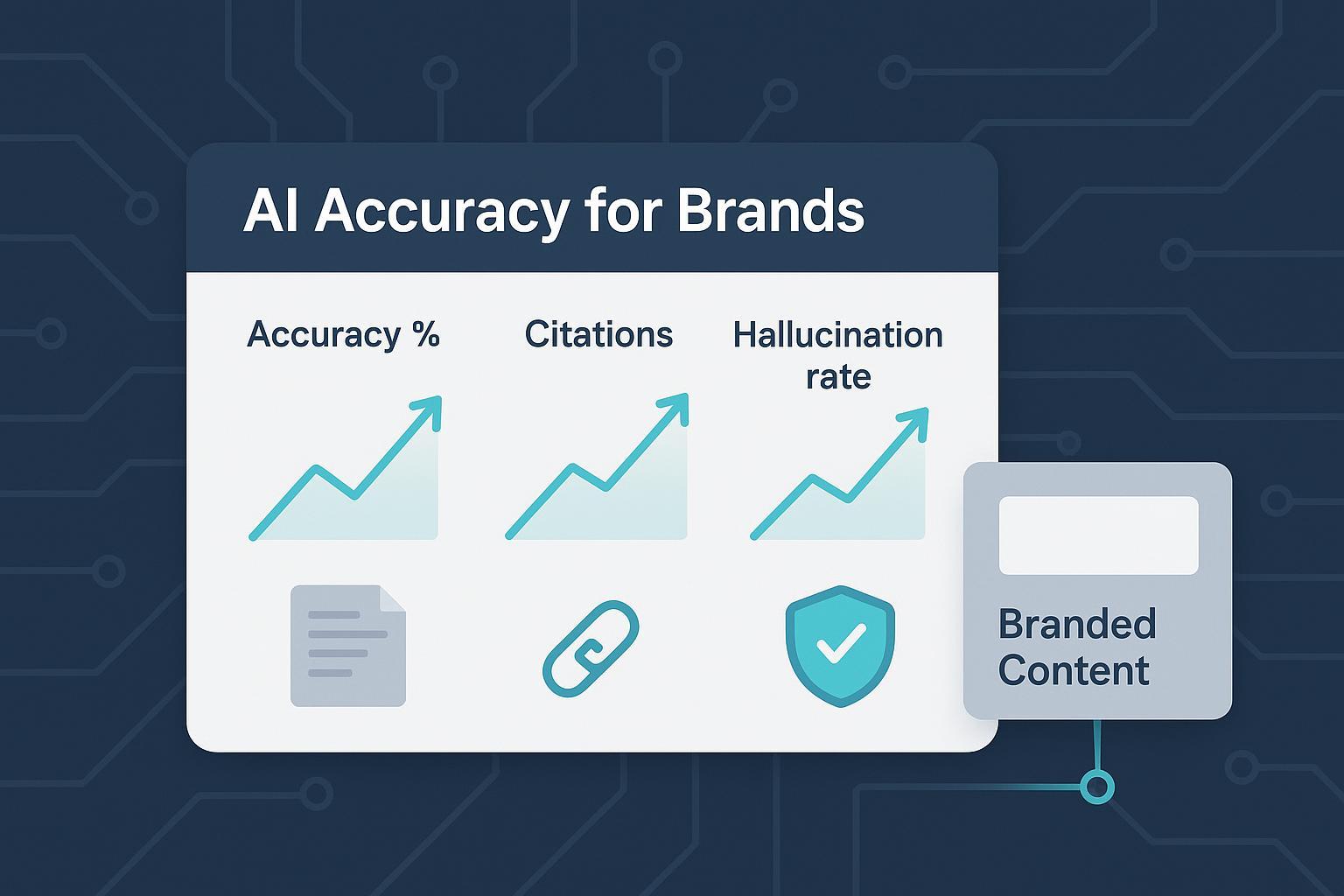
When AI gets brand facts wrong, customers don’t just lose trust—they bounce, they complain, and they buy elsewhere. In peer-reviewed tests, general chatbots still hallucinate at meaningful rates: a 2024 study reported 28.6% for GPT‑4, 39.6% for GPT‑3.5, and 91.4% for Bard across specific tasks, underscoring why grounding and oversight matter (JMIR 2024 hallucination rates). The good news: retrieval‑augmented generation (RAG) with curated sources can drop errors dramatically—down near 2% in a controlled setup versus much higher without robust retrieval, according to a 2025 paper (Peer‑reviewed RAG effectiveness, 2025).
The Brand Accuracy Stack
1) System instructions and prompt design
Think of system instructions as your brand’s operating manual inside the model. Define scope, allowed sources, required outputs, and how uncertainty must be handled. Google’s Gemini/Vertex guidance emphasizes explicit systemInstruction fields and structured prompts to reduce errors and enforce constraints (Vertex AI prompt design intro).
Practical moves:
- Anchor non‑negotiable rules in the system prompt (persona, scope boundaries, citation format).
- Use stepwise reasoning (think in steps) and ask clarifying questions when inputs are ambiguous.
- Set output schemas (e.g., JSON with fields for claim, source author, date, URL).
2) Grounding via RAG and vetted sources
RAG reduces hallucinations by retrieving facts from a vetted corpus at answer time. OpenAI’s Responses API enables retrieval and exposes “receipts” of tool calls for auditability—so teams can trace where facts came from (OpenAI Responses API).
Practical moves:
- Restrict retrieval to a single source of truth: your KB, policy docs, specs, and help center.
- Log tool calls and citations so reviewers can validate evidence.
- Prefer short, well‑labeled passages; embed metadata (author, date, @id) to help the model extract clean citations.
3) Citations and uncertainty handling
Accuracy is not just “getting it right”—it’s showing where the facts came from and admitting gaps. Require visible citations and instruct the model to flag uncertainty. This aligns with transparency expectations in frameworks like the NIST AI Risk Management Framework (Govern/Map/Measure/Manage) published in 2024 (NIST AI RMF).
Practical moves:
- Enforce citation extraction (author, title, year, URL) and display sources inline.
- Allow “I don’t know” or prompt for clarifying context when evidence is insufficient.
- For engines that natively show sources (e.g., Bing Copilot, Perplexity), ensure your content is authoritative and structured to earn citations.
4) Knowledge base quality and Schema.org
Your KB is the foundation. Structure content cleanly, version changes, and add structured data so AI systems and search engines can understand entities and relationships. Google’s docs recommend JSON‑LD for structured data; validate regularly (Google’s structured data intro).
Practical moves:
- Assign KB ownership; maintain a single source of truth for FAQs, specs, policies.
- Use Schema.org with persistent IDs (
@id) to tie entities together. - Validate JSON‑LD in CI/CD; track update history and approvals.
5) Evaluation, monitoring, and ROI
You can’t improve what you don’t measure. Baseline accuracy on curated test sets; regression‑test prompts and workflows; monitor brand citations in AI answers and correlate with business outcomes.
Practical moves:
- Use evaluation harnesses (e.g., RAGAS/G‑Eval variants) to score factuality, citation correctness, and coherence on a golden dataset.
- Run prompt A/B tests with suites like Promptfoo or Rank Prompt to stabilize outputs and increase citation inclusion.
- Track KPIs: Accuracy %, Citation correctness %, Evidence coverage %, Uncertainty signaling rate, Hallucination rate, First‑contact resolution, Share of voice in AI answers, CTR to owned sources, and cost‑to‑serve/ROI.
The Step‑by‑Step Playbook
- Define scope and risks
- Classify domains (support policies, pricing, compliance). Identify high‑risk areas that need human oversight.
- Build the single source of truth
- Consolidate KB content; modularize answers; add Schema.org JSON‑LD with
@idfor entities.
- Design system prompts and output schemas
- Specify persona, allowed sources, citation format, uncertainty rules; define JSON fields for outputs and citations.
- Implement RAG and logging
- Connect retrieval to vetted sources; log tool calls and sources; prefer short, well‑tagged chunks.
- Test and iterate
- Establish a golden dataset; evaluate with RAGAS/G‑Eval; run prompt regression suites; fix weak spots.
- Monitor and govern
- Create dashboards for accuracy/citation KPIs; set review cadences; document oversight and audits.
Platform Notes (what to enable and watch)
- OpenAI (Responses API): Enable retrieval tools for grounding; capture “receipts” for audit; maintain conversation state for consistent context (OpenAI Responses API).
- Google Gemini via Vertex AI: Use systemInstruction and structured prompts; refine prompts to reduce errors (Vertex AI prompt design intro).
- Bing Copilot / Perplexity: These experiences display citations inline. Ensure your articles and KB pages are authoritative, fast, and richly structured so they’re eligible for citation. Platform documentation evolves—verify policies and features before rollout.
- Anthropic/Claude: Follow safety/system card guidance and practical prompting advice; keep a strong evaluation loop. Consolidated developer pages on citation enforcement are limited—monitor official updates.
Governance, compliance, and oversight
If your AI system answers customers, it’s not just a UX feature—it’s regulated. The EU AI Act entered into force in 2024 with obligations phasing through 2026 for transparency, documentation, and human oversight in higher‑risk uses. Customer‑facing generative AI must disclose AI interaction and mark synthetic outputs, and organizations should design oversight workflows accordingly. See Article 13, Article 50, and Annex XII on transparency (EU AI Act overview page). The NIST AI RMF (2024) offers an operational blueprint—Govern, Map, Measure, Manage—for risk classification, accuracy monitoring, and documentation (NIST AI RMF).
What to document:
- Data lineage: where facts come from and how they’re updated.
- Prompts and constraints: system instructions, allowed sources, uncertainty rules.
- Evaluation results and audits: accuracy, citation correctness, regression histories.
- Human oversight: when reviewers must intervene and escalation paths.
Case snapshots and realistic metrics
- Support RAG in enterprise: LinkedIn reported a 28.6% decrease in median resolution time after retrieval improvements—an operational impact closely tied to better grounding. Public sources summarize the change without granular hallucination deltas.
- Retail/ecommerce: Case roundups show inventory or ticketing accuracy improvements (e.g., 15%–40% gains), which are operational metrics rather than LLM hallucination rates; they still illustrate the payoff of structured data and vetted sources.
- Finance/product: One report observed hallucinations dropping from 34.1% to 3.9% after a model/workflow switch—directional evidence that strong grounding and evaluation can slash errors.
Treat these as directional snapshots unless you have internal data. Your own golden dataset and KPI dashboard will be far more persuasive.
Templates and examples
System prompt scaffold (adapt for your brand):
System role: You are a brand‑safe assistant.
Scope: Answer only about our products, policies, and support.
Sources: Use only vetted documents from our KB. If a claim isn’t in the KB, ask a clarifying question or say you don’t know.
Citations: Return author, title, year, and URL for every factual claim.
Output format: JSON with fields {answer, claims[], citations[]}. Keep answers concise and accurate.
Uncertainty: If sources conflict or are missing, state uncertainty and request clarification.
Safety/compliance: Escalate legal/healthcare queries to human review.
Mini JSON‑LD example for a product FAQ page:
{
  "@context": "https://schema.org",
  "@type": "FAQPage",
  "@id": "https://example.com/faq#product-a",
  "mainEntity": [{
    "@type": "Question",
    "name": "Is Product A compatible with Feature X?",
    "acceptedAnswer": {
      "@type": "Answer",
      "text": "Yes. Product A supports Feature X starting in version 3.2 (released Jan 2025)."
    }
  }]
}
Accuracy KPI table (adapt columns to your dashboard):
| KPI | Definition | Target |
|---|---|---|
| Accuracy % | Share of answers fully correct on the golden dataset | ≥ 95% |
| Citation correctness % | Share of claims with valid, precise citations | ≥ 90% |
| Evidence coverage % | Portion of answers backed by at least one vetted source | ≥ 95% |
| Hallucination rate | Share of answers containing unsupported claims | ≤ 5% |
| Uncertainty signaling rate | Cases where the assistant appropriately flags uncertainty | 100% in ambiguous cases |
| First‑contact resolution | Support issues solved without escalation | +10–20% vs. baseline |
| Share of voice (AI answers) | % of AI answers citing your brand pages | Upward trend |
| CTR to owned sources | Click‑through from AI answers to your content | Upward trend |
| Cost‑to‑serve | Support cost per resolved issue | Downward trend |
Further reading
- Practical prompting techniques from Nucamp’s 2025 guide.
- Agentic prompting and evaluation tips in Beam.ai’s “Stop Wasting Prompts”.
- Developer‑focused prompting insights on Claude’s best practices.
- Operational KB guidance in Zendesk’s AI knowledge base overview (2025).
Make accuracy your brand advantage
Here’s the deal: accuracy isn’t luck—it’s a discipline. Tight system instructions, RAG with vetted sources, enforced citations, a clean KB with JSON‑LD, and continuous evaluation will move your metrics in the right direction. Start by shipping a small golden dataset and a system prompt scaffold, then iterate. Which pillar will you tackle first?