How Agencies Can Offer Fast-Turnaround SEO Content (Without Torching Quality)

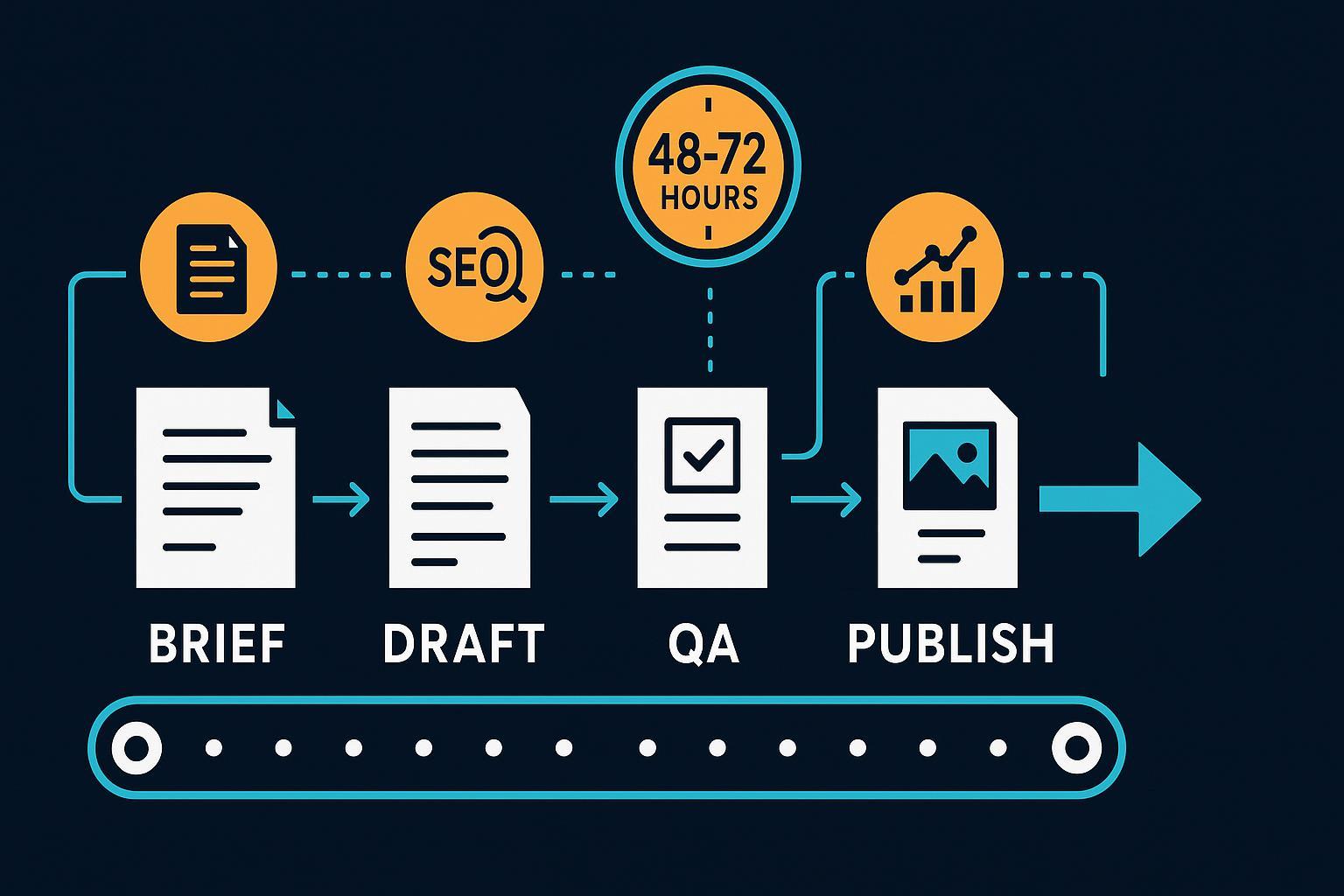
Shaving days off your SEO content timeline is tempting—until quality slips, rankings stall, and revisions pile up. The fix isn’t hustle; it’s a gated workflow that blends automation with experienced editorial judgment. Below is the 48–72 hour model my teams use to ship reliably at speed.
The 48–72 Hour SLA Model for SEO Content
Speed works only when you lock in non-negotiable gates—brief clarity, fact-checking, technical hygiene, and client feedback discipline. Think of it like a production line with “stop points.” If a gate fails, the piece doesn’t advance.
| SLA Window | Milestone | What Must Be True |
|---|---|---|
| Day 0 (Hours 0–2) | Intake & Prioritization | Ticket has target query cluster, intent, page owner, internal link targets, acceptance criteria |
| Hours 0–6 | Research & Brief | SERP/intent mapped, entities defined, outline drafted, sources identified, schema type chosen |
| Hours 6–24 | Drafting | Draft covers questions/entities, cites primary sources, includes internal links and AEO-style direct answers |
| Hours 24–36 | Editor QA & Optimization | Accuracy verified, E-E-A-T evident, on-page elements polished, schema prepared |
| Hours 36–48 | Technical Prep & Publishing | Canonicals, indexability, structured data validate; CMS preview ready |
| Hours 48–72 | Client Review & Final | One consolidated round of feedback, final edits shipped or staged |
Quality gates align with platform guidance: prioritize people-first utility and originality, and avoid scaled, thin outputs. Google’s current guidance on creating helpful content and spam enforcement makes this explicit; automation is fine, manipulation isn’t. See Google’s own documentation on creating helpful content and the March 2024 core update and spam policies for context.
Roles and Collaboration in a High-Velocity Team
Speed collapses when roles blur. Set crisp ownership so handoffs are clean and rework is rare.
- Content Operations Lead: owns the queue, SLAs, and handoffs; enforces gates.
- SEO Strategist: clusters queries, maps intent, defines entities, selects schema.
- AI‑Aided Writer: drafts against the brief, embeds citations and internal links, adds firsthand perspective.
- Editor/QA: fact-checks, strengthens narrative, ensures E‑E‑A‑T signals and on-page optimization.
- Technical SEO: validates structured data, indexability, and Core Web Vitals implications.
- PM/Client Partner: manages approvals and timeboxes feedback.
The End-to-End Workflow (What to Do Each Phase)
-
Intake & Prioritization (Day 0): Create a standard ticket with topic, target query cluster, intent, URL/section owner, internal link targets, success metric, and acceptance criteria. Route via Asana/Monday. This clarity prevents scope drift later.
-
Research & Brief (Hours 0–6): Combine keyword tools (e.g., Semrush/Ahrefs) with SERP reads to identify questions, entities, and outline sections. Decide schema (FAQ, HowTo, Article) and cite 1–2 primary sources you will reference. A light automation layer helps here; Yoast’s perspective on SEO automation tasks outlines practical checks you can wire early in WordPress.
-
Drafting (Hours 6–24): Move fast with an outline-to-draft pass, but inject experience—mini anecdotes, specific examples, and precise citations. Use AEO formatting for the top questions: a 40–60 word direct answer under the subhead, then context. Amsive’s 2025 guide to Answer Engine Optimization aligns well with this structure.
-
Editor QA & Optimization (Hours 24–36): Your editor is the fail-safe. They validate facts, improve clarity, verify author credentials/byline, and polish on-page elements. They also prepare schema and check internal links. If something breaks here, it goes back to drafting.
-
Technical Prep & Publishing (Hours 36–48): Load to CMS, validate canonicals, indexability, and structured data, and preview. If you publish to production later, tag the change log for reporting.
-
Client Review & Final (Hours 48–72): Offer one consolidated feedback window (24 hours). Capture requests in a structured form and iterate quickly. Publish or schedule, then annotate in your reporting.
Your 2025 Automation Stack (Minimalist, Interoperable)
You don’t need 20 tools; you need a few that talk to each other. Here’s a practical wiring that consistently cuts hours without adding complexity.
-
Research/Outlines/Scoring: Surfer, Clearscope, or Frase for SERP-aligned coverage and scoring. Surfer’s own automation overview shows how to centralize outline and optimization to reduce editor rework; see Surfer’s content automation overview.
-
Routing & Publishing: AirOps for templated briefs and drafts, Zapier or n8n for moving artifacts (brief → Google Docs → CMS), and Slack/Asana notifications for approvals. MarketerMilk’s 2025 roundup of the best SEO automation tools captures these categories and why they matter.
-
CMS QA: Yoast for automated metadata, schema scaffolding, and internal link suggestions inside WordPress; pair with manual checks for anything mission-critical.
-
Reporting: Looker Studio dashboards reading Search Console/Analytics; append release annotations to tie outcomes to content drops.
Keep the stack small until your cycle-time data proves a bottleneck. Then add selectively.
Quality Gates That Keep You Compliant and Competitive
These are the guardrails that let you move quickly without tripping spam or quality issues. Miss one and the piece stops moving.
- Editor QA checklist (use this as your single-page audit):
- Verify claims against primary sources and update any statistics to the current year in text.
- Ensure E‑E‑A‑T signals: byline + bio, organizational credentials, and firsthand experience/examples.
- On-page polish: compelling title/meta, hierarchical headers, descriptive internal anchors, image alts.
- Schema validation (FAQ/HowTo/Article as planned) and indexability/canonicals confirmed.
- Accessibility basics (contrast, alt text, link clarity) and Core Web Vitals considerations.
- Final read for originality and voice—does it sound like your agency, not a template?
If you’re thinking, “Won’t all this slow us down?”—it’s actually the opposite. Clear gates reduce rework and revisions, which are the real time killers.
Format for Speed: AEO/GEO Patterns and Programmatic SEO
Structure content so both humans and AI systems can parse it quickly. Question-led subheads with short direct answers near the top improve scannability and give AI systems clean snippets to cite. Maintain entity consistency (people, brands, topics), and keep citation hygiene tight.
If you’re scaling topical pages, programmatic SEO can help—but only with robust templates that avoid thinness. A practical starter is to design templates with unique elements per page (aim for 30–40% differentiated copy, original data points, and bespoke internal links). For a grounded overview of programmatic planning and pitfalls, see Exploding Topics’ beginner’s guide to programmatic SEO (2025).
Client Ops That Prevent Delays
Client delays can destroy a 72-hour plan. Set expectations on Day 0 and automate reminders.
- Onboarding essentials: a short roadmap, communication plan, portal access, and approval criteria. The Automattic guide to agency client onboarding is a solid model.
- Feedback SLAs: one consolidated round in a 24-hour window; a structured form (scope, tone, claims) to keep requests specific.
- Reporting rhythm: weekly status with what shipped, what’s queued, and leading indicators; monthly outcomes with context and annotations.
Measuring Velocity and Impact
You can’t improve what you don’t measure. Track these four indicators on every piece for 60 days:
- Cycle time by phase (hours): intake to brief, brief to draft, draft to QA, QA to publish, publish to approval.
- Rework rate: returns from editor to writer; count and categorize the causes.
- Content scorecard: coverage/optimization score at draft vs. final; editor changes in words/percent.
- Early ROI proxies: impressions to clicks lift on the target cluster, internal link assist traffic, and time on page. Tie milestones to Search Console annotations.
Common anti-patterns to avoid: tool sprawl, generic outlines with no POV, skipping schema, and accepting open-ended client feedback windows. The moment you allow unbounded revisions, your SLA evaporates.
Your Next 7-Day Pilot
Here’s the deal: pick one content cluster and run the full workflow on two assets next week. Baseline your current cycle times, then run the SLA model and compare. Did the editor catch fewer issues? Did the client respond faster? If the answer is yes, roll it out to the next cluster and keep tightening your gates.
When speed is the goal, rigor is your friend. Build the gates, wire the automations, and let your editors be the heroes who keep the line moving—and your reputation intact.