How Agencies Can Provide Content Briefs With AI (Without Losing Quality or Control)

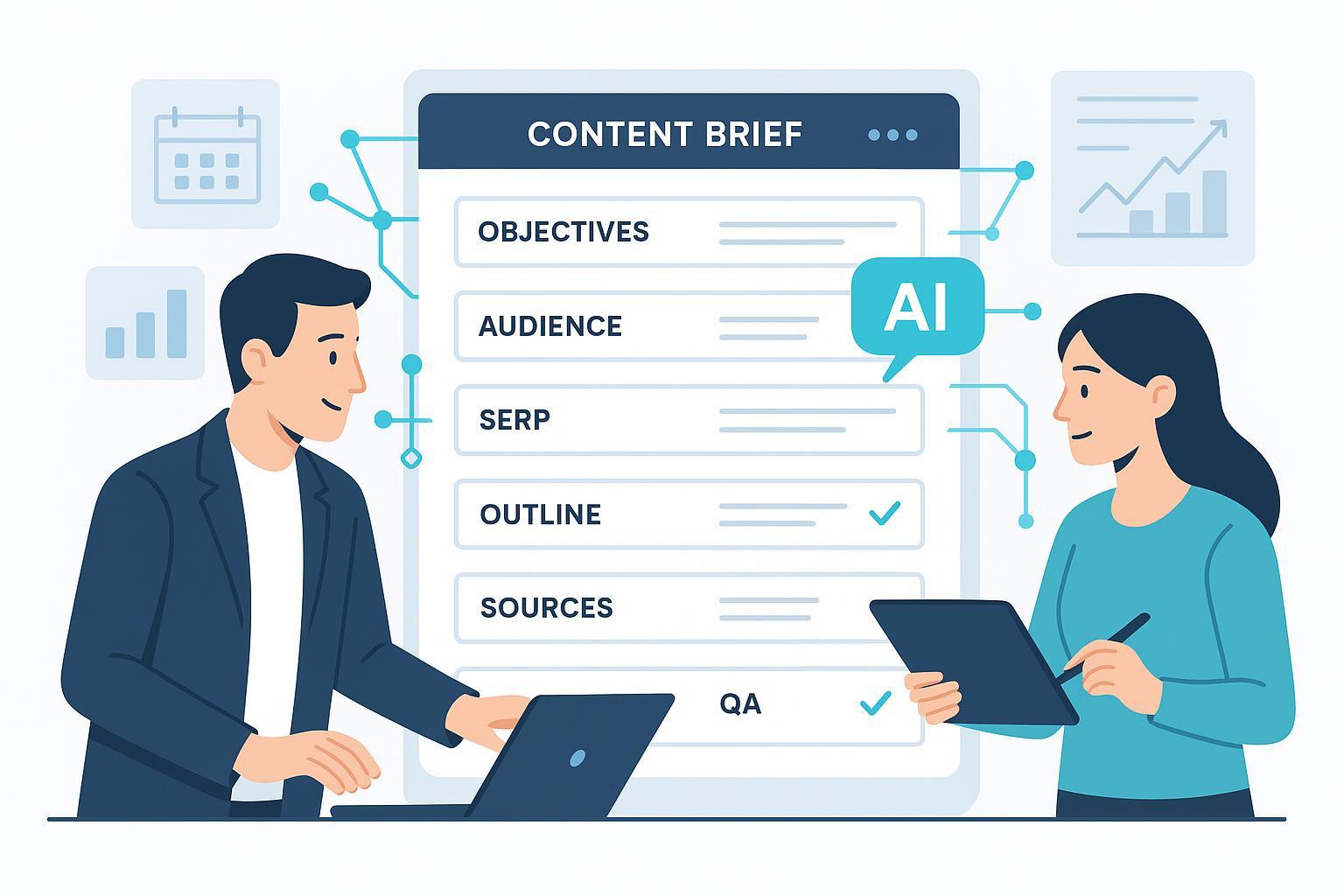
If your writers are still chasing context across tabs and Slack threads, you don’t have a talent problem—you have a briefing problem. AI can’t replace editorial judgment, but it can compress research, structure, and stakeholder inputs into a clear brief in minutes. The trick is building a workflow where AI accelerates the work and your team safeguards accuracy, voice, and strategy.
According to Google’s guidance, the bar hasn’t changed: publish “helpful, reliable, people-first content,” regardless of how it’s produced. See Google’s current principles in Creating helpful content (2024–2025) for how quality is assessed and where automation fits when outputs serve users well. Read: the tool doesn’t absolve quality; your process does. Source: Google’s Creating helpful content guidance: Create helpful, reliable, people-first content.
What a 2025‑ready content brief actually includes
A strong AI-assisted brief gives writers clarity and editors control. At minimum, cover: objectives and audience; search intent and topical scope; SERP summary and competitor angles; primary keywords plus related entities; proposed H1–H3 outline with mandatory talking points; brand voice and reading level; required sources and internal links; compliance notes (if regulated); deliverables and logistics; and success metrics. If you need a public benchmark for structure, Semrush’s 2025 template explains intent alignment, headings, links, and tone in a stepwise way: How to write an SEO content brief: guide & template.
An end‑to‑end agency workflow (human-in-the-loop by design)
Use AI for speed and synthesis; use people for judgment, originality, and accountability.
| Stage | What AI Assists | Human Owner | QA / Gate |
|---|---|---|---|
| Strategy intake | Summarize ICP, product USPs, past performance notes | Strategist/AM | Confirm objectives, constraints, must-link pages |
| Research | SERP scan, topic/entity map, competitor outline diff | SEO lead | Validate intent, add missing sources, de-duplicate |
| Draft brief | Generate outline, sections, entities, questions, link targets | Content lead | Check voice, originality, evidence placeholders |
| Review | Suggest examples, stats to verify, risks/bias flags | Editor/SME | Fact-check, add citations, finalize angle |
| Handoff | Convert to Docs/Notion; tasks to PM tool | PM | Assign reviewers, lock version, due dates |
| Production | Draft copy, snippets, visuals with AI assists | Writer/Designer | Editorial pass, plagiarism and accessibility checks |
| Publish & measure | Extract SEO metadata, track KPIs | SEO/Analytics | Verify technical SEO; set review cadence |
| Learn & iterate | Summarize wins/gaps; update prompts/templates | Ops lead | Quarterly retro; update playbook |
Think of AI as the research assistant and structure coach; your leads still sign off on intent, claims, and voice.
A reusable prompt pattern your team can standardize
The goal is consistency. Use a single prompt pattern with variables and attach your brand guide, ICP notes, and a SERP snapshot.
Role: You are an agency content strategist creating a writer-ready brief.
Goal: Produce a structured brief for [TOPIC] that matches [SEARCH INTENT] and aligns with [BUSINESS OBJECTIVE].
Inputs:
- Audience/ICP: [PASTE]
- Brand voice/style rules: [PASTE]
- SERP snapshot (titles/URLs/notes): [PASTE]
- Keywords/entities: [PRIMARY], [SECONDARY LIST]
- Internal links to include: [URLS]
- Compliance constraints: [NOTES]
Deliverable: Return a brief with sections: Objectives, Audience, Search Intent, SERP Summary (gaps/opportunities), Keywords & Entities, Outline (H1–H3 + bullets), Evidence & Sources (placeholders with suggested primary sources), Brand Voice Notes, Internal/External Links, Compliance Checks, Deliverables & Logistics, Success Metrics. Ask 3 clarification questions at the end if inputs are incomplete.
Constraints: Cite authoritative sources only; avoid speculation; flag any claims needing verification.
Tips that matter:
- Always paste a mini-SERP snapshot (top 5 titles and why they rank) and your must-link internal pages. AI performs better with concrete context than with generic “best practices.”
- If your brand voice is nuanced, include one short paragraph of “voice do/don’t” and two sample lines of approved copy.
Governance and risk controls (so you scale safely)
Two simple truths: what gets shipped gets measured, and what’s measured can be governed. Ground your process in recognized frameworks and marketing-specific guidance.
- Google’s quality bar applies regardless of tooling. Their stance on automation is clear: it’s acceptable when content is helpful and policy-compliant. See: Create helpful, reliable, people-first content.
- For AI governance principles (validity, reliability, documentation), many marketing teams adapt the NIST AI Risk Management Framework to content pipelines (versioning, human approvals, incident handling).
- For marketing-specific guardrails (accuracy checks, disclosure, audit trails), align with the MMA’s 2025 guidance: Generative AI Governance Framework for Marketing.
Practical controls to bake into briefs and reviews:
- Require source suggestions in the brief, and verify every non-common fact before drafting.
- Run a bias/fairness pass: would this guidance misrepresent or exclude key audiences? Document mitigations in reviewer notes.
- Maintain prompt/version history and reviewer sign-offs in your PM tool. It’s your audit trail if claims are questioned later.
Advanced use cases and integrations
- Multi-format: Extend the brief to video and social with hooks, beats, CTAs, and cutdowns per channel. Add shot lists or storyboard beats for video.
- Localization: Include locale-specific terminology, examples, and regulatory notes. Require a local SME sign-off.
- Regulated industries: Add substantiation standards, required disclaimers, and approval sequences. If the topic is sensitive, set stricter source tiers (e.g., primary research, regulators, peer-reviewed).
- Stack integration: Store briefs in Docs/Notion; manage approvals and due dates in Asana/Trello/Jira; track performance in GA4/Search Console/Data Studio; archive everything in your knowledge base.
Measurement: prove the lift, then tune prompts
You’ll get pressure to show ROI quickly. Use a simple baseline: average time to produce a writer-ready brief, number of revisions, and time-to-draft for the first article produced from it. Directionally, marketers report material time savings from genAI; for instance, Salesforce’s 2025 snapshot found that 71% of marketers expect genAI to save them 5 hours per week, with widespread usage for content tasks: Generative AI statistics (2025). Trade media reporting suggests agencies can trim initial brief creation by roughly a third, depending on maturity and inputs—see Digiday’s field coverage: How agencies are using generative AI to speed up creative briefs. Your mileage will vary, so treat these as direction, not promises.
A weekly 30-minute retro on shipped content should ask: Did we match intent better? Are outlines clearer? Where did writers stall? Feed those answers back into your prompt variables and template.
Pitfalls to avoid (and how to fix them fast)
- Thin SERP context: If you don’t paste real SERP notes, AI hallucinates structure. Fix: add top titles/URLs and “why they rank” comments.
- Voice drift: Generic tone creeps in. Fix: include 2–3 voice traits and sample lines; have editors do a voice pass on outlines.
- Unverified stats: AI suggests shaky numbers. Fix: require primary source citations and a fact-check step before drafting.
- Over-long briefs: Writers get lost. Fix: keep sections scannable; move deep research to an appendix or linked doc.
- Tool lock-in: One platform dictates your process. Fix: document the process first; pick tools that export and integrate cleanly.
Your 30‑day action plan
- Week 1: Catalog current brief elements and time-to-brief baseline. Draft a standard template and choose your prompt variables.
- Week 2: Pilot on three topics. Enforce the human review gates and capture issues in a shared log.
- Week 3: Add governance artifacts (prompt history, reviewer checklist, source policy). Integrate with your PM tool.
- Week 4: Report results (time saved, revision count, writer satisfaction). Update the template and prompts; roll out to a larger pod.
Want a quick sanity check? Ask yourself: if a new writer joined tomorrow, could they produce an on-voice first draft from your brief without Slacking anyone for missing context? If the answer’s “not yet,” now you know where to start.